
Read time
42 min
Charts
0 visuals
Tables
9 data blocks
FAQs
25 answered
Executive Summary
A complete student accommodation booking timeline for international students, covering when to start searching, when to book, city-level booking pressure, room demand, intake planning, parent checks, contract risks, deposits, scams and expert guidance.
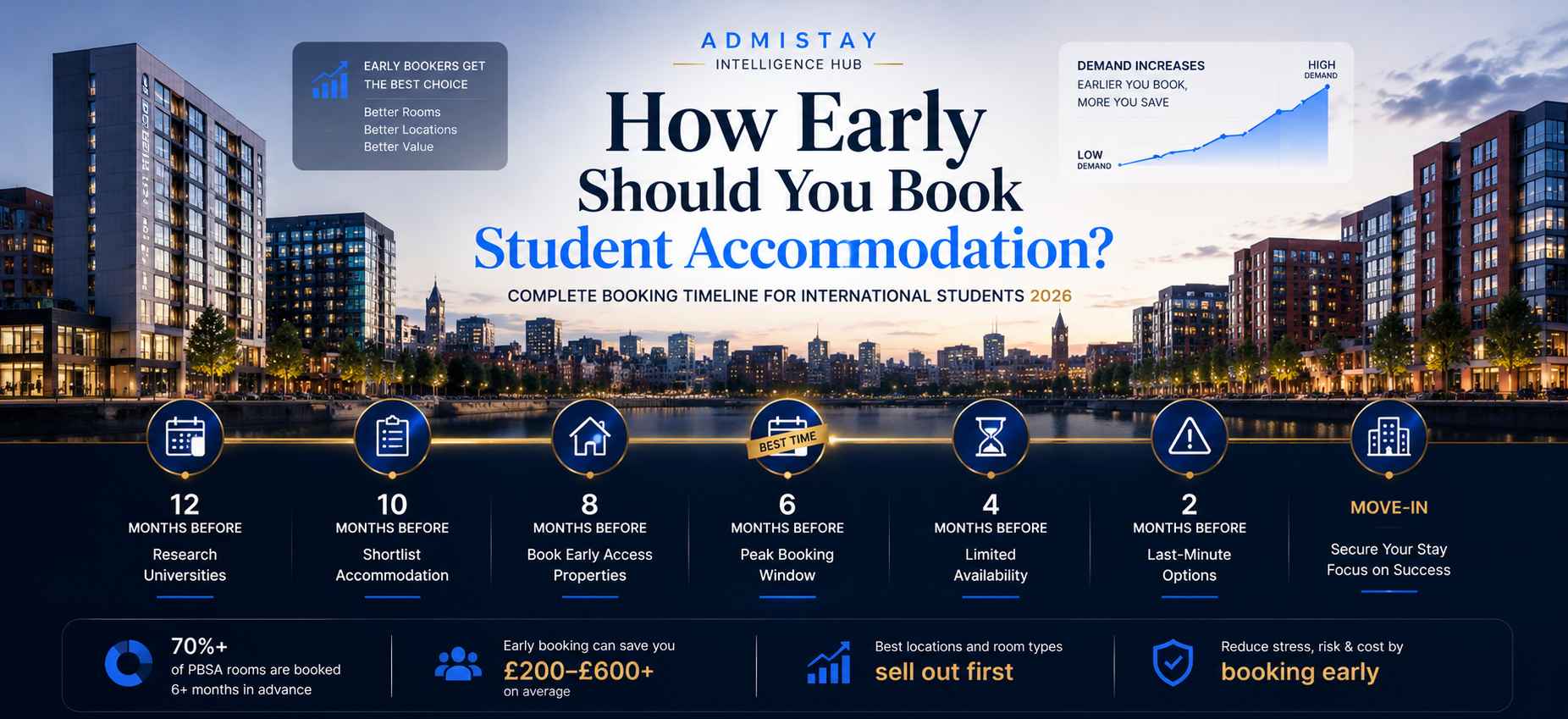
How Early Should You Book Student Accommodation? Complete Booking Timeline for International Students 2026
A research-led booking strategy for international students and parents planning safe, verified and budget-conscious accommodation before university arrival.
When should international students book accommodation?
Student accommodation is one of the most important decisions an international student makes before arriving at university. It affects rent, safety, commute time, contract flexibility, student wellbeing, parent confidence and overall study experience. The best room is not always the cheapest room; the strongest decision balances affordability, location, provider credibility and long-term comfort.
Students should not wait until the final visa or travel stage before thinking about accommodation. Research can begin early without making an immediate payment. The ideal approach is to understand city options early, shortlist suitable rooms once the university choice becomes clearer, and book only after reviewing contract terms, cancellation rules, payment schedule and move-in requirements.
Students can begin with verified city options such as student accommodation in London, student accommodation in Edinburgh, student accommodation in Birmingham, student accommodation in Cambridge, student accommodation in Newcastle, student accommodation in Leicester, student accommodation in Wembley and student accommodation in Kingston upon Thames.
Admistay booking intelligence findings
Early research improves choice
Students who begin early can compare location, rent, room type, commute, bills, deposits and contract flexibility without pressure.
Studios and ensuite rooms move first
Private room types usually receive stronger demand because they offer privacy, independence and comfort for international students.
City risk is not equal
London, Edinburgh and Cambridge often require earlier planning than more flexible student housing markets.
Late booking increases compromise
Students booking late may still find accommodation, but often compromise on commute, room type, price or contract terms.
Parents should compare total annual cost
Weekly rent alone is not enough. Transport, deposits, laundry, bills, safety and emergency flexibility affect real affordability.
Intake timing matters
September intake is the most competitive. January and May intake students may get more flexibility but should still avoid last-minute booking.
The ideal student accommodation booking timeline
12 Months Before Arrival
Goal: Understand destination, budget and accommodation types.
Low Risk- Shortlist possible countries, cities and universities.
- Understand PBSA, shared housing, university halls, studios and ensuite rooms.
- Estimate weekly rent and annual living cost.
- Discuss budget comfort with parents or sponsors.
- Decide whether safety, location, privacy or affordability matters most.
9 Months Before Arrival
Goal: Start serious accommodation research.
Low to Moderate Risk- Compare accommodation in shortlisted university cities.
- Check commute times from popular student areas.
- Compare room types by privacy, price and contract length.
- Create a shortlist of 5–10 suitable accommodation options.
- Review cancellation flexibility if your university decision is not final.
6 Months Before Arrival
Goal: Move from research to booking readiness.
Moderate Risk- Confirm your likely university and campus location.
- Compare final options by price, location, room type and contract terms.
- Check whether bills are included.
- Review deposit, guarantor and instalment requirements.
- Prepare documents required for booking.
3 Months Before Arrival
Goal: Finalise accommodation before availability becomes restricted.
High Risk if Delayed- Choose the final property and room type.
- Read the tenancy agreement carefully before payment.
- Confirm cancellation policy, cooling-off period and visa-related clauses.
- Check move-in date, tenancy length and payment schedule.
- Save receipts and written confirmations.
1 Month Before Arrival
Goal: Complete arrival preparation and avoid last-minute mistakes.
Very High Risk- Confirm check-in process and arrival time.
- Arrange airport transfer or first-day travel route.
- Check what is included in the room.
- Confirm emergency contact, reception hours and move-in instructions.
- Avoid paying unknown individuals or unverified listings.
Booking strategy by university intake
| Intake | Best Research Window | Best Booking Window | Risk if Delayed |
|---|---|---|---|
| September Intake | October–January | January–April | Very High |
| January Intake | June–August | August–October | Moderate to High |
| May Intake | January–February | February–March | Moderate |
September intake booking roadmap
September intake students face the strongest competition because this is the main arrival period for UK universities. Students targeting high-demand cities should begin comparing accommodation before spring and avoid leaving decisions until summer.
January intake booking roadmap
January intake students should begin planning during the previous summer. Availability may be more flexible than September, but students still need to consider contract start dates, winter arrival, deposit terms and campus commute.
May intake booking roadmap
May intake students should begin planning early in the calendar year. This intake can sometimes offer more room flexibility, but students should check whether contracts match their course duration.
City booking difficulty and recommended timelines
| City | Booking Difficulty | Recommended Window | Risk Level | Useful Link |
|---|---|---|---|---|
| London | Very High | 6–9 months early | Very High | Student Accommodation London |
| Edinburgh | High | 5–8 months early | High | Student Accommodation Edinburgh |
| Cambridge | High | 5–8 months early | High | Student Accommodation Cambridge |
| Birmingham | Moderate to High | 4–6 months early | Moderate | Student Accommodation Birmingham |
| Newcastle | Moderate | 3–5 months early | Moderate | Student Accommodation Newcastle |
| Leicester | Moderate | 3–5 months early | Moderate | Student Accommodation Leicester |
| Wembley | High | 5–7 months early | High | Student Accommodation Wembley |
| Kingston upon Thames | Moderate to High | 4–6 months early | Moderate | Student Accommodation Kingston upon Thames |
City booking scorecards
London Booking Scorecard
| Booking Difficulty | 10/10 |
| Studio Demand | 10/10 |
| Last-Minute Risk | 10/10 |
| Parent Confidence Need | 10/10 |
Edinburgh Booking Scorecard
| Booking Difficulty | 9/10 |
| Studio Demand | 9/10 |
| Last-Minute Risk | 9/10 |
| Parent Confidence Need | 9/10 |
Birmingham Booking Scorecard
| Booking Difficulty | 8/10 |
| Studio Demand | 8/10 |
| Last-Minute Risk | 7/10 |
| Parent Confidence Need | 8/10 |
Cambridge Booking Scorecard
| Booking Difficulty | 9/10 |
| Studio Demand | 8/10 |
| Last-Minute Risk | 9/10 |
| Parent Confidence Need | 9/10 |
Which room types sell out first?
| Room Type | Demand | Sell-Out Speed | Best For | Booking Advice |
|---|---|---|---|---|
| Premium Studio | Very High | Fastest | Postgraduates, couples, independent living | Book earliest |
| Studio | Very High | Very Fast | Students seeking privacy | Start 7–9 months early |
| Ensuite | High | Fast | Most international students | Start 5–7 months early |
| Non-Ensuite | Moderate | Moderate | Budget-conscious students | Compare value carefully |
| Shared Room | Lower | Slower | Students prioritising affordability | Check privacy and contract terms |
Contract, deposit, guarantor and bills checklist
Deposit Checks
- Amount payable before booking
- Refund conditions
- Payment deadline
- Receipt confirmation
Guarantor Checks
- Whether a guarantor is required
- Whether international guarantors are accepted
- Alternative payment options
- Instalment rules
Bills Checks
- Electricity
- Water
- Heating
- Internet
- Laundry or extra service charges
Cancellation Checks
- Cooling-off period
- Visa refusal clause
- University rejection clause
- Replacement tenant condition
How to avoid accommodation scams when booking early or late
Do
- Use verified student accommodation platforms.
- Check the property and provider details.
- Ask for written booking confirmation.
- Read the tenancy agreement before payment.
- Keep screenshots, receipts and emails.
Avoid
- Paying through personal bank accounts.
- Booking from social media screenshots only.
- Sending money without a contract.
- Trusting unrealistic discounts.
- Ignoring pressure tactics such as “pay immediately or lose the room”.
Booking recommendations by student profile
Indian Undergraduate Student
Recommended window: 6–8 months before arrival.
Best fit: Ensuite or PBSA room with strong support and safety features.
Common risk: Waiting until visa approval before researching.
Indian Postgraduate Student
Recommended window: 7–9 months before arrival.
Best fit: Studio or quiet ensuite near campus or transport.
Common risk: Underestimating studio demand in major cities.
Nigerian Student
Recommended window: 6–8 months before arrival.
Best fit: Bills-included accommodation with flexible payment clarity.
Common risk: Not checking payment schedule and guarantor requirements.
Chinese Postgraduate Student
Recommended window: 8–10 months before arrival.
Best fit: Studio or premium ensuite in a safe, well-connected area.
Common risk: Delaying too long for preferred studio options.
Saudi Student
Recommended window: 7–9 months before arrival.
Best fit: Private room or studio with good facilities and transport access.
Common risk: Choosing premium rooms without checking commute convenience.
Budget-Conscious Student
Recommended window: 5–7 months before arrival.
Best fit: Non-ensuite or shared apartment with clear bills and transport access.
Common risk: Choosing the cheapest rent without calculating commute cost.
Parent accommodation decision framework
Safety Checklist
- Secure entry
- Reception or support availability
- Safe commute route
- Emergency contact process
- Verified provider details
Financial Checklist
- Deposit amount
- Instalment schedule
- Bills included or excluded
- Refund rules
- Guarantor requirement
Contract Checklist
- Tenancy length
- Cancellation policy
- Cooling-off period
- Visa-related clause
- Move-in and move-out dates
Location Checklist
- Distance to campus
- Transport connections
- Grocery access
- Healthcare access
- Night-time safety
Student accommodation mistakes to avoid
- Waiting for visa approval before even researching accommodation.
- Booking only because the weekly rent looks cheap.
- Ignoring commute time and transport cost.
- Not checking whether bills are included.
- Not reading the cancellation policy.
- Paying unknown individuals through personal bank accounts.
- Booking based only on images or social media messages.
- Ignoring tenancy length.
- Not checking guarantor requirements.
- Leaving booking until the final travel month.
- Not comparing room types properly.
- Ignoring safety and support features.
- Not saving payment confirmations.
- Choosing location without checking campus distance.
- Assuming all properties allow flexible move-in.
When should you book based on your situation?
| Student Situation | Recommended Booking Window | Reason |
|---|---|---|
| London student | 6–9 months early | High demand and limited central inventory. |
| Edinburgh student | 5–8 months early | Competitive student housing market. |
| Cambridge student | 5–8 months early | Limited central accommodation supply. |
| Postgraduate student | 7–9 months early | Studios and quieter options can move faster. |
| Budget student | 5–7 months early | More time to compare value options. |
| Last-minute applicant | Immediately after final decision | Prioritise verified listings and safe contracts. |
Admistay Accommodation Booking Intelligence Index 2026
The Admistay Booking Intelligence Index is an editorial framework used to evaluate how early students should plan accommodation in a destination. It considers student demand, city popularity, accommodation supply, room-type pressure and timing risk.
| Factor | Weight | Why It Matters |
|---|---|---|
| International Student Demand | 25% | Higher demand increases booking pressure. |
| City Popularity | 20% | Major cities attract wider student competition. |
| Accommodation Supply | 20% | Limited supply creates faster room movement. |
| Room Type Pressure | 15% | Studios and ensuite rooms often move earlier. |
| Timing Risk | 20% | Late decisions reduce flexibility. |
Admistay Expert Verdict
International students should not wait until the final visa or travel stage to begin accommodation planning. The best strategy is to research 6–9 months before arrival, shortlist 4–6 months before arrival and complete booking 3–6 months before move-in. High-demand cities require earlier planning, especially for students who want studios, ensuite rooms, safer locations or shorter commutes.
The right accommodation decision should balance price, safety, commute, contract flexibility and student comfort. The cheapest option is not always the best option, and the most expensive room is not always the most suitable. Students and parents should focus on total value.
Methodology, source transparency and editorial standards
This guide is prepared by the Admistay Research Team using student accommodation market observations, student enquiry patterns, university city demand, public accommodation availability patterns and editorial review. Exact availability and pricing can vary by provider, city, intake, contract length and room type. Students should verify live prices, policies and room availability before making payment.
The guide separates factual guidance, practical observations and expert recommendations. It does not invent live availability, guaranteed pricing or provider-specific claims. Where accommodation rules vary by property or provider, students are advised to verify the latest contract, cancellation and payment terms directly before booking.
FAQs
How early should I book student accommodation?
Most international students should start researching 6–9 months before arrival and book 3–6 months before move-in.
Is January too early to book student accommodation for September intake?
No. January is usually a strong time to compare and shortlist rooms for September intake, especially in high-demand cities.
Is June too late to book student accommodation?
June is not always too late, but premium rooms and better locations may already be limited in competitive cities.
Should I book accommodation before getting my visa?
Students should research early, but they must check cancellation policies and visa-related clauses before committing.
Which room types sell out fastest?
Studios, premium studios and ensuite rooms usually attract the strongest demand.
Which UK city requires the earliest booking?
London usually requires the earliest planning because of high demand and limited central accommodation supply.
Can I find student accommodation one month before arrival?
Yes, but options may be limited and students should prioritise verified listings and safe contracts.
Do student rooms become cheaper closer to move-in?
Not always. Waiting can sometimes reduce choice and increase compromise.
What should parents check before booking?
Parents should check safety, location, provider credibility, cancellation terms, deposit rules, bills and support availability.
How can students avoid accommodation scams?
Students should use verified listings, avoid personal bank transfers, read contracts carefully and keep written confirmation of every payment.
When should January intake students book accommodation?
January intake students should usually start researching during the previous summer and aim to book by autumn.
When should May intake students book accommodation?
May intake students should usually research in January or February and book before travel planning becomes urgent.
Should I book the cheapest accommodation?
Not always. Students should compare total value including commute, safety, bills, contract terms and support.
What is the safest way to pay for student accommodation?
Students should pay through verified provider channels and keep official receipts, booking confirmations and contracts.
What if my visa is delayed?
Students should check visa-related cancellation or deferral clauses before booking and keep written evidence of provider terms.
Do I need a guarantor?
Some providers require a guarantor or upfront payment. International students should confirm this before choosing a property.
Are bills included in student accommodation?
Many PBSA options include bills, but students must confirm electricity, water, heating, internet and any fair-usage limits.
Is PBSA better for international students?
PBSA can be suitable for international students because contracts, bills, facilities and support services are usually clearer.
Should postgraduate students book earlier?
Yes. Postgraduate students often prefer studios or quieter rooms, which can attract early demand.
Is it safe to book from social media listings?
Students should be cautious. Social media listings must be verified carefully before payment or document sharing.
What documents are needed for booking accommodation?
Requirements vary, but students may need passport details, university information, guarantor details and payment confirmation.
Can I change accommodation after booking?
It depends on provider policy. Students should review cancellation, replacement tenant and transfer conditions before booking.
What is a cooling-off period?
A cooling-off period is a limited time after booking when cancellation may be possible under provider terms.
How should parents compare accommodation?
Parents should compare safety, commute, provider credibility, contract terms, total annual cost and emergency support.
What is the biggest late-booking risk?
The biggest risk is being forced to compromise on safety, location, commute, room type or contract flexibility.
Frequently Asked Questions
Student Accommodation FAQs
Practical answers for students, parents, universities and providers.
1How early should I book student accommodation?
How early should I book student accommodation?
Most international students should start researching 6–9 months before arrival and book 3–6 months before move-in.
2Is January too early to book student accommodation for September intake?
Is January too early to book student accommodation for September intake?
No. January is usually a strong time to compare and shortlist rooms for September intake, especially in high-demand cities.
3Is June too late to book student accommodation?
Is June too late to book student accommodation?
June is not always too late, but premium rooms and better locations may already be limited in competitive cities.
4Should I book accommodation before getting my visa?
Should I book accommodation before getting my visa?
Students should research early, but they must check cancellation policies and visa-related clauses before committing.
5Which room types sell out fastest?
Which room types sell out fastest?
Studios, premium studios and ensuite rooms usually attract the strongest demand.
6Which UK city requires the earliest booking?
Which UK city requires the earliest booking?
London usually requires the earliest planning because of high demand and limited central accommodation supply.
7Can I find student accommodation one month before arrival?
Can I find student accommodation one month before arrival?
Yes, but options may be limited and students should prioritise verified listings and safe contracts.
8Do student rooms become cheaper closer to move-in?
Do student rooms become cheaper closer to move-in?
Not always. Waiting can sometimes reduce choice and increase compromise.
9What should parents check before booking?
What should parents check before booking?
Parents should check safety, location, provider credibility, cancellation terms, deposit rules, bills and support availability.
10How can students avoid accommodation scams?
How can students avoid accommodation scams?
Students should use verified listings, avoid personal bank transfers, read contracts carefully and keep written confirmation of every payment.
11When should January intake students book accommodation?
When should January intake students book accommodation?
January intake students should usually start researching during the previous summer and aim to book by autumn.
12When should May intake students book accommodation?
When should May intake students book accommodation?
May intake students should usually research in January or February and book before travel planning becomes urgent.
13Should I book the cheapest accommodation?
Should I book the cheapest accommodation?
Not always. Students should compare total value including commute, safety, bills, contract terms and support.
14What is the safest way to pay for student accommodation?
What is the safest way to pay for student accommodation?
Students should pay through verified provider channels and keep official receipts, booking confirmations and contracts.
15What if my visa is delayed?
What if my visa is delayed?
Students should check visa-related cancellation or deferral clauses before booking and keep written evidence of provider terms.
16Do I need a guarantor?
Do I need a guarantor?
Some providers require a guarantor or upfront payment. International students should confirm this before choosing a property.
17Are bills included in student accommodation?
Are bills included in student accommodation?
Many PBSA options include bills, but students must confirm electricity, water, heating, internet and any fair-usage limits.
18Is PBSA better for international students?
Is PBSA better for international students?
PBSA can be suitable for international students because contracts, bills, facilities and support services are usually clearer.
19Should postgraduate students book earlier?
Should postgraduate students book earlier?
Yes. Postgraduate students often prefer studios or quieter rooms, which can attract early demand.
20Is it safe to book from social media listings?
Is it safe to book from social media listings?
Students should be cautious. Social media listings must be verified carefully before payment or document sharing.
21What documents are needed for booking accommodation?
What documents are needed for booking accommodation?
Requirements vary, but students may need passport details, university information, guarantor details and payment confirmation.
22Can I change accommodation after booking?
Can I change accommodation after booking?
It depends on provider policy. Students should review cancellation, replacement tenant and transfer conditions before booking.
23What is a cooling-off period?
What is a cooling-off period?
A cooling-off period is a limited time after booking when cancellation may be possible under provider terms.
24How should parents compare accommodation?
How should parents compare accommodation?
Parents should compare safety, commute, provider credibility, contract terms, total annual cost and emergency support.
25What is the biggest late-booking risk?
What is the biggest late-booking risk?
The biggest risk is being forced to compromise on safety, location, commute, room type or contract flexibility.
Continue Research
Related student intelligence
Internal Links
Continue with the most relevant Admistay pages from this article.
Admissions
Explore admissions guidance connected to this article.
Related Articles
Read the next Intelligence Hub guides on this theme.
Why trust this guide
Admistay Research Team
International Student Accommodation & Admissions Analysts
Specialists in student accommodation planning, international admissions, student mobility and city-level housing guidance.
Reviewed by
Admistay Editorial Review Team
Student Housing & Admissions Research Review