
Read time
24 min
Charts
6 visuals
Tables
18 data blocks
FAQs
15 answered
Executive Summary
Learn how to avoid student accommodation scams in the UK in 2026. Check fake listings, landlords, deposits, tenancy contracts, HMO licences, payment risks and safe booking steps before paying.
Accommodation Scam Risk by Booking Urgency
Derived risk model showing how scam exposure increases when students search under late-booking pressure.
Insight: Highest signal is Final month at 90.
Common Student Accommodation Scam Types
Risk score by common scam pattern affecting student renters.
Insight: Highest signal is Fake listing at 95.
Student Accommodation Verification Steps
Relative importance of checks before paying a deposit.
Insight: Highest signal is Verify provider at 95.
Accommodation Route Scam Risk
Risk score by accommodation booking route.
Insight: Highest signal is Unverified listing at 95.
City-Level Scam Exposure Pressure
Derived city exposure score based on rent pressure, student demand, international student booking risk and late-booking urgency.
Insight: Highest signal is London at 95.
Parent Confidence Safety Factors
Relative importance of parent and guarantor checks before approving payment.
Insight: Highest signal is Provider verification at 95.
Research Tables
Data Tables & Decision Frameworks
Structured evidence tables, source notes and Admistay decision frameworks used throughout this report.
Executive Snapshot
Safety guidance based on official UK renting rules, student visa demand context and Admistay derived risk frameworks.
| Metric | Value | Verification Status |
|---|---|---|
| Primary student risk | Fake listings and pressure-based deposits | derived |
| Highest-risk booking stage | Last-minute search before intake | derived |
| Key legal check | Tenancy deposit protection where applicable | official guidance |
| Key HMO check | Large HMO licensing where required | official guidance |
Source Confidence Matrix
Defines evidence hierarchy used for this safety guide.
| Tier | Source Type | Confidence | Use |
|---|---|---|---|
| Tier 1 | Official government guidance | High | Deposit protection, HMO licensing, visa guidance |
| Tier 2 | University and student support guidance | High | Student accommodation verification and support routes |
| Tier 3 | Fraud reporting/news/academic research | Medium-high | Rental fraud patterns and scam behaviour |
| Tier 4 | Admistay derived models | Derived | Risk scores, frameworks and decision support |
Common Student Accommodation Scam Type Matrix
Admistay synthesis based on rental fraud patterns and student booking risk.
| Scam Type | How It Works | Red Flag |
|---|---|---|
| Fake listing | A non-existent or unavailable room is advertised. | Cheap rent and payment before verification |
| Cloned listing | Real photos are copied and reused with fake contact details. | Same images appear elsewhere with different details |
| Fake landlord | A person pretends to own or manage the property. | Payment account does not match verified owner or provider |
| Fake tenant transfer | Someone claims they can transfer a room without provider approval. | No written permission to assign or sublet |
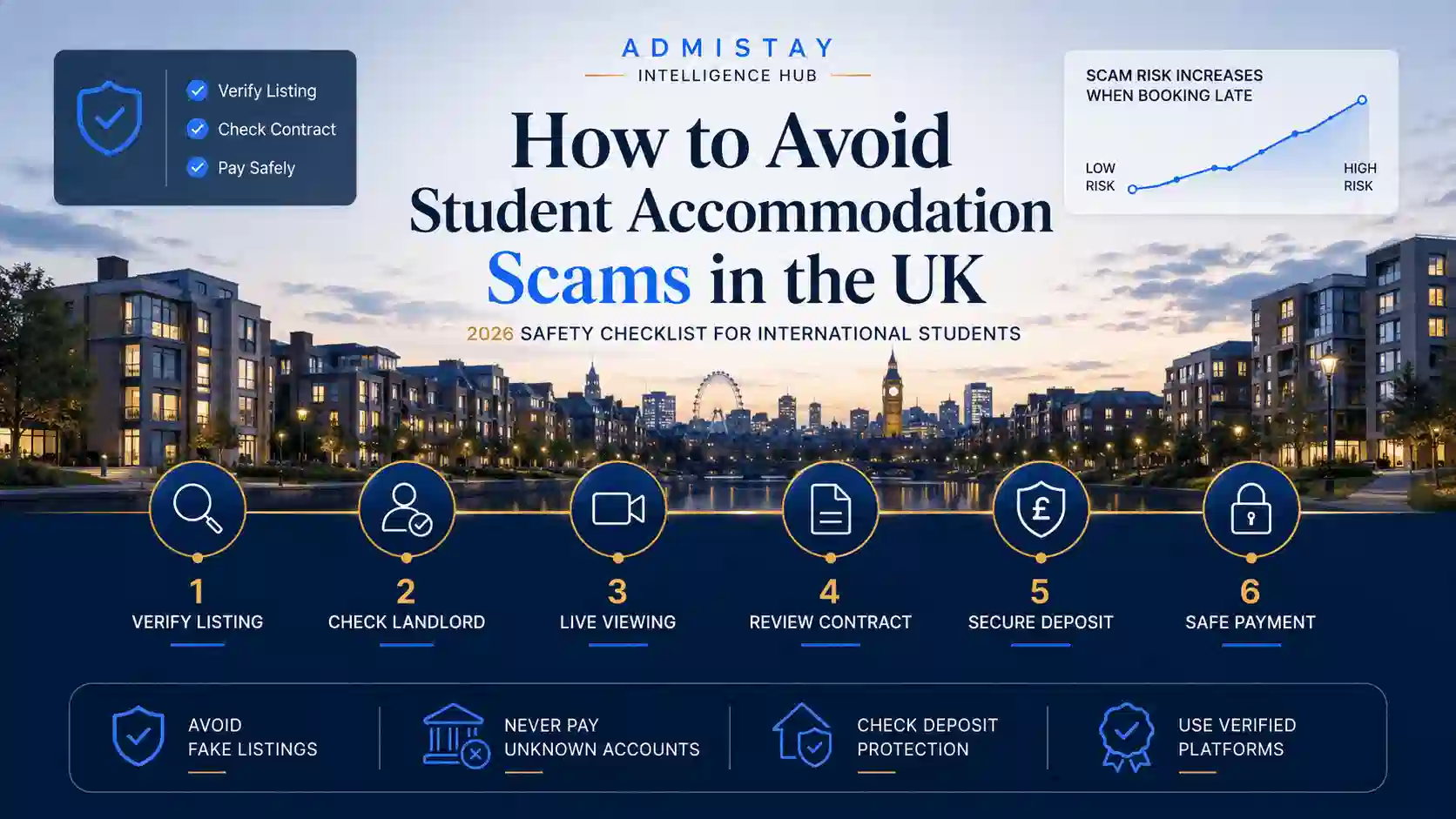
2026 Student Accommodation Safety Checklist
Admistay operational checklist for students and parents.
| Step | Safe Signal | Stop If |
|---|---|---|
| Verify listing | Realistic price, full address and consistent photos | Address is vague or price is far below market |
| Check landlord or provider | Identity can be verified independently | Only social profile or generic email is provided |
| Live viewing | Exterior, entrance, room and shared areas are shown live | Only pre-recorded videos are sent |
| Review contract | Names, dates, rent, bills and cancellation terms are clear | Blank fields or mismatched names appear |
| Secure deposit | Deposit type and protection route are clear | No written refund or protection details |
| Safe payment | Account name matches verified landlord, provider or agency | Asked to pay crypto, gift cards or unrelated personal account |
Deposit and Payment Safety Rules
Based on UK tenancy deposit guidance and student booking best practice.
| Payment Type | Student Check | Risk |
|---|---|---|
| Holding deposit | Get written terms before paying | May be non-refundable under some conditions |
| Tenancy deposit | Confirm protection route where applicable | Deposit may be lost if paid to fake landlord |
| Rent in advance | Pay only after provider and contract verification | Large financial loss if listing is fake |
| Personal account transfer | Confirm account name and official payment route | High fraud risk if account is unrelated |
Student Tenancy Contract Checklist
Admistay contract review checklist for students and parents.
| Contract Item | What To Check |
|---|---|
| Property address | Full address, room, building and flat details |
| Legal parties | Student, landlord, provider or agent names |
| Rent | Amount, due dates, payment method and late fees |
| Deposit | Amount, purpose, protection and refund terms |
| Bills | Electricity, water, heating, internet and fair-use caps |
| Cancellation | Cooling-off, visa refusal, replacement tenant and move-in terms |
City-Level Scam Risk Table
Derived city exposure model; not official statistics.
| City | Risk Pattern | Recommendation |
|---|---|---|
| London | Cheap listings are tempting due to high rent | Verify provider identity and avoid social-media-only rooms |
| Manchester | Large student demand creates urgency | Compare rent by area and check agent details |
| Birmingham | Mixed PBSA and private rental market | Check contract, bills and location before deposit |
| Edinburgh | Competitive housing market and early pressure | Start early and avoid last-minute unverified listings |
| Leeds | Strong student districts and shared housing demand | Check HMO condition, landlord identity and bills |
| Coventry | International student demand and room transfer activity | Verify room transfer permission before payment |
Parent and Guarantor Safety Matrix
Admistay parent decision framework.
| Parent Concern | Check |
|---|---|
| Safety | Secure access, building support and route safety |
| Payment | Official payment account, invoice and receipt |
| Contract | Rent, dates, cancellation and guarantor liability |
| Provider | Official website, reviews, support process and email domain |
| Student wellbeing | Commute, area, facilities and maintenance response |
What To Do If Scammed
Action pathway for students after suspected rental fraud.
| Step | Action |
|---|---|
| Contact bank | Ask for urgent fraud support and payment recall if possible |
| Save evidence | Keep listing screenshots, messages, payment proof and contract |
| Report platform listing | Report the profile and listing where it was found |
| Tell university | Ask accommodation or international office for emergency support |
| Report fraud | Use the relevant police or fraud reporting route for the UK nation |
How to Avoid Student Accommodation Scams in the UK: 2026 Safety Checklist
A practical safety guide for students, international applicants and parents checking UK student accommodation listings, landlords, deposits, contracts and payments before booking.
How can students avoid accommodation scams in the UK?
Student accommodation scams in the UK are especially risky because students often search under pressure before September or January intake. International students face an even higher challenge because they may be booking from overseas, comparing unfamiliar areas and trying to secure a room before visa travel. Fraudsters exploit this urgency by advertising fake rooms, copied property photos, fake tenancy agreements, low prices and pressure-based deposit requests.
This guide gives students and parents a repeatable safety process: verify the listing, verify the person, verify the property, verify the paperwork, verify the payment route and verify legal protections before sending money. Students can also reduce risk by comparing verified options such as student accommodation in London, student accommodation in Manchester, student accommodation in Birmingham, student accommodation in Leeds and student accommodation in Edinburgh.
Student accommodation scam risk in 2026
- Scammers target students because the housing decision is urgent, emotional and financially important.
- Fake listings often use attractive photos, below-market rent, social media groups and pressure to pay quickly.
- A tenancy agreement alone does not prove a listing is genuine because fake paperwork can be created easily.
- Students should ask for proof of authority to let, live viewing, exact property address and clear payment terms.
- Deposits should be protected through an approved tenancy deposit scheme where the law requires it.
- Large HMOs in England usually need local council licensing, so shared student houses should be checked carefully.
- Parents and guarantors should review payment details, contract names and refund rules before funding deposits.
- International students should involve their university accommodation or international office quickly if they suspect fraud.
Why student accommodation scams happen in the UK
The UK remains one of the world’s most active student housing markets. UCAS reported that January 2026 UK 18-year-old applicants reached 338,940, up 4.8% year on year, while international undergraduate applicants through UCAS reached 124,830, up 5.1%. The Home Office also reported 426,471 sponsored study visas in the year ending December 2025, including 406,824 main applicants. This level of demand creates real pressure around major student cities, especially before autumn intake.
Fraudsters use that pressure to create urgency. A student may be told that the room will be gone tonight, that many people are interested, that the landlord is travelling, or that the current tenant can only send a video. These stories are designed to make students skip normal checks. The safest response is to slow the decision down and verify each part of the booking chain before paying.
| Market pressure | How scammers exploit it | Student protection |
|---|---|---|
| High demand before September intake | Pressure to pay immediately | Compare verified options early and do not rush deposits |
| International students booking from overseas | Fake live tours and copied images | Use live video, trusted representatives or verified providers |
| Rising rent in major cities | Unrealistically cheap rooms | Compare local rent ranges before trusting a deal |
| Social media housing groups | Fake landlord or fake tenant profiles | Check identity, property control and payment route |
| Last-minute accommodation panic | Advance rent or holding deposit pressure | Read contract and confirm refund terms before payment |
Common student accommodation scams in the UK
| Scam type | How it works | Red flag |
|---|---|---|
| Fake listing scam | A property is advertised even though it does not exist, is not available or is not controlled by the advertiser. | The rent is unusually cheap and the advertiser asks for money before proper checks. |
| Cloned listing scam | Photos and descriptions are copied from a real listing and reposted with different contact details. | The same photos appear on other websites with different prices or addresses. |
| Fake landlord scam | A person pretends to own or manage the property and sends fake tenancy paperwork. | The name on the payment account does not match the landlord, agent or provider. |
| Fake current tenant scam | A supposed tenant claims they are leaving and can transfer the room after receiving a deposit. | The person cannot show proof that they have the right to assign or sublet the room. |
| Holding deposit scam | A student is asked to pay a small amount to reserve the room without written terms. | No clear refund rules, no receipt and no formal property verification. |
| Advance rent scam | The student is asked to pay several months upfront before the contract is properly checked. | Large upfront payment requested to a personal account before signing. |
| Fake agent scam | A fraudster impersonates a letting agent, university partner or provider. | Email domain, website, phone number or company details do not match independently verified records. |
The 2026 student accommodation safety checklist
| Step | What to verify | Safe signal | Stop if... |
|---|---|---|---|
| 1 | Listing | Price, photos, address and description look consistent with the local market. | The rent is far below market or the address is vague. |
| 2 | Advertiser identity | Full name, company, role, email domain, phone and office details can be checked independently. | The person only uses WhatsApp, Messenger or a generic email and refuses details. |
| 3 | Property control | The person can prove they are the landlord, agent, PBSA provider or authorised tenant. | They cannot prove legal authority to let the room. |
| 4 | Viewing | You view in person or through a live video showing the exterior, entrance, room and shared spaces. | Only pre-recorded videos are shared and live viewing is refused. |
| 5 | Contract | The agreement has the exact address, named parties, rent, dates, bills, deposit and cancellation terms. | The contract has blank fields, wrong names or pressure to sign without reading. |
| 6 | Deposit | The deposit process is explained clearly and scheme protection is confirmed where required. | The advertiser says deposit protection is not needed without explanation. |
| 7 | Payment | The account name matches the verified provider or landlord and a receipt is issued. | You are asked for crypto, gift cards, cash, foreign transfer services or money to an unrelated account. |
| 8 | Move-in | Move-in date, key collection, emergency contact and inventory are confirmed in writing. | Details keep changing after payment. |
How to verify a student accommodation listing
Start by checking whether the listing looks realistic for the city. A studio in central London, Edinburgh or Manchester that is priced far below similar rooms should not be trusted only because the photos look good. Search the property address, compare the building on maps, check whether the same images appear elsewhere, and ask why the price is lower than the market.
Questions to ask before viewing
- What is the full property address and room number?
- Are you the landlord, agent, provider or current tenant?
- Can you prove you have permission to let this room?
- Can I do an in-person viewing or live video viewing?
- What exactly is included in the rent?
- What deposit or holding payment is required?
- How will the tenancy deposit be protected?
- Can you send the full contract before payment?
How to verify a landlord or letting agent
Do not rely only on the name shown on a social media profile. Ask for the advertiser’s full legal name, role, company details, website, office address and email domain. If they claim to be an agency, search the agency independently and call the official number from the agency website, not the number sent by the advertiser. If they claim to be a current tenant, ask for written permission from the landlord or provider allowing the transfer, assignment or sublet.
| Advertiser claim | Verification action |
|---|---|
| “I am the landlord” | Ask for proof of ownership or proof of right to let and compare payment name with the landlord name. |
| “I am an agent” | Check the agency website, address, official phone number, redress scheme and email domain. |
| “I am the current tenant” | Ask for written provider or landlord permission before paying anything. |
| “I work with the university” | Confirm directly with the university accommodation team using the official university website. |
| “I can guarantee the room if you pay today” | Ask for written terms, verified contract and official payment process before paying. |
Deposit and payment safety rules
Deposits are one of the easiest points for scammers to exploit. Before paying, ask whether the payment is a holding deposit, tenancy deposit, rent in advance or booking fee. Ask what happens if you do not pass checks, if the landlord withdraws, if your visa is delayed or if the room is not as described.
In England and Wales, tenancy deposits for relevant tenancy types must be protected through a government-approved tenancy deposit scheme within the required period. Holding deposits are different because they are paid to hold a property before the agreement is signed, but students should still ask for written terms before sending any money.
Never pay through these routes
- Cryptocurrency
- Gift cards
- Cash to an unknown person
- Money transfer services requested by a stranger
- “Friends and family” payment routes
- Personal accounts unrelated to the landlord, agent or provider
- Payment links from unverified emails or social media profiles
Payment proof to keep
- Listing screenshots
- All WhatsApp, email and platform messages
- Bank transfer confirmation
- Contract or draft contract
- Receipt
- Name of the payee
- Deposit protection information
Student tenancy contract checklist
A contract should make the booking clearer, not more confusing. Students should not sign a tenancy agreement that has blank spaces, mismatched names, incorrect address details, unexplained fees or unclear cancellation terms. Parents and guarantors should review the same contract before funding payments.
| Contract detail | What to check |
|---|---|
| Property address | Full address, building, flat or room number |
| Legal parties | Your name, landlord or provider name and agent details if relevant |
| Rent | Amount, frequency, due date and payment method |
| Deposit | Amount, purpose, protection route and refund rules |
| Tenancy dates | Start date, end date, move-in date and cancellation rules |
| Bills | Electricity, gas, water, heating, internet, laundry and fair-usage limits |
| Guarantor | Who needs to sign, what liability they accept and payment alternatives |
| Repairs | Who handles maintenance and emergency issues |
| Inventory | Condition report and evidence process at move-in |
Are PBSA, HMO or private rentals safer?
No accommodation type is automatically risk-free, but managed PBSA and university-managed halls usually offer clearer booking processes, published provider details, structured payments, support teams and furnished student rooms. HMOs and private rentals can be more affordable, but they require stronger verification around landlord identity, HMO licensing, deposit protection, repairs and housemate arrangements.
| Accommodation type | Typical safety strength | Main risk to check |
|---|---|---|
| University halls | Strong institutional verification | Availability and contract flexibility |
| PBSA | Managed process, student facilities and clearer support | Cancellation terms, fees and room availability |
| HMO | Can be affordable and good for groups | Licensing, property condition, landlord reliability and bills |
| Private rental | Flexible but highly variable | Fake listings, deposit risk, repairs and contract quality |
| Social media room transfer | Can work only with proper permission | Fake tenant, no authority to sublet or assign the room |
Students comparing housing types can also read PBSA vs HMO student accommodation comparison and when to book student accommodation before finalising a room.
Extra scam checks for international students
International students should be especially careful when booking from outside the UK. Scammers know that overseas students may not know local rent levels, tenancy wording, payment norms or UK city neighbourhoods. Do not let visa urgency, flight dates or university deadlines push you into unsafe payments.
- Use official university accommodation pages, verified providers or trusted student accommodation platforms.
- Ask your university if a provider or area is known to them.
- Do not trust anyone claiming they can guarantee admission, visa approval and accommodation together.
- Keep your CAS, visa, passport, booking confirmation and payment proof in cloud storage.
- Tell your university international office immediately if housing fraud affects your arrival or enrolment.
- Ask for visa refusal, delayed arrival and cancellation clauses in writing before booking.
Parent and guarantor safety checklist
Parents often fund deposits or act as guarantors, so they should not approve payment without checking the same evidence as the student. A guarantor agreement can create serious financial responsibility, so it must be read carefully before signing.
| Parent concern | What to check |
|---|---|
| Safety | Secure entry, building management, emergency contact and location |
| Payment | Account name, invoice, receipt and official payment route |
| Contract | Rent, dates, deposit, cancellation policy and guarantor liability |
| Provider | Official website, reviews, office address, support process and email domain |
| Student wellbeing | Commute, area safety, facilities, social support and maintenance response |
What to do if you think you have been scammed
If you have already paid money, act quickly. Contact your bank first and explain that you may have been the victim of rental fraud. Preserve all evidence, including listing screenshots, messages, phone numbers, emails, bank details, contracts and profile links. Report the listing to the platform where you found it. If you are a student, tell your university accommodation office or international student support team the same day.
Evidence folder checklist
- Listing URL and screenshots
- Advertiser name, phone number, email and social profile
- All messages and call logs
- Bank payment confirmation
- Contract, draft contract or receipt
- Property address and photos
- Timeline of what happened
- University application or student ID details if relevant
City-level scam risk and booking pressure
Scam risk is usually highest when demand, rent pressure and urgency are highest. London, Edinburgh, Manchester, Birmingham, Leeds, Coventry, Nottingham and Glasgow all have large student markets, but the risk is not only the city. The real risk is late booking through unverified channels.
| City | Risk pattern | Admistay recommendation |
|---|---|---|
| London | High rent and strong demand can make cheap listings tempting. | Verify provider identity and avoid social media-only rooms. |
| Manchester | Large student market and popular neighbourhoods create urgency. | Compare rent by area and check agent details. |
| Birmingham | Mixed PBSA, private rental and shared housing market. | Check contract, bills and location before deposit. |
| Edinburgh | Competitive housing market with early booking pressure. | Start early and avoid last-minute unverified listings. |
| Leeds | Strong student districts and shared housing demand. | Check HMO condition, landlord identity and bills. |
| Coventry | International student demand and room transfer activity. | Verify room transfer permission before payment. |
| Nottingham | Mix of student homes, PBSA and budget options. | Check property condition and deposit protection. |
| Glasgow | Different Scottish deposit and tenancy rules. | Check Scotland-specific guidance and provider policies. |
Messages students can copy before paying
Message to landlord or agent
Hello, I am interested in the room at [full address]. Before I pay any deposit, please confirm your full name, whether you are the landlord or agent, the company name if applicable, your official email, the full property address, whether a live viewing is available, whether the property needs an HMO licence, how the deposit will be protected and when I will receive the signed contract and receipt.
Message to university accommodation team
Hello, I am an incoming student and I am checking a possible accommodation option. Could you please advise whether [provider / address / listing URL] is known to the university or whether there are any concerns I should check before paying a deposit?
Message after suspected scam
Hello, I believe I may have been targeted by an accommodation scam. I paid £[amount] on [date] for [property/listing]. The advertiser used [phone/email/profile]. I have saved screenshots, payment proof and messages. Please advise what steps I should take and whether the university can support temporary accommodation or verification.
Admistay Student Accommodation Scam Risk Index
The Admistay Scam Risk Index is an editorial framework for assessing whether a student accommodation listing should be trusted before payment. It does not replace legal advice, but it helps students and parents identify risk before money is transferred.
| Factor | Weight | Low-risk signal | High-risk signal |
|---|---|---|---|
| Provider verification | 25% | Official website, verified contact, clear company identity | Only social media or private messaging |
| Property verification | 20% | Exact address, live viewing, property matches listing | Vague location or only edited videos |
| Payment safety | 20% | Traceable payment to verified business or landlord | Unrelated personal account or unusual payment method |
| Contract clarity | 15% | Full contract with names, dates, rent and cancellation terms | Blank fields, wrong names or contract after payment |
| Legal protection | 10% | Deposit protection and HMO licensing explained where relevant | No answer on deposit or licensing |
| Behavioural red flags | 10% | Calm, professional communication | Pressure, excuses, urgency and emotional manipulation |
Common mistakes students should avoid
- Paying before viewing or verifying the property.
- Trusting a listing only because the photos look professional.
- Assuming a tenancy agreement proves the property is genuine.
- Sending money to an account name that does not match the provider or landlord.
- Booking through social media without independent checks.
- Ignoring deposit protection and refund rules.
- Not checking whether a shared house needs an HMO licence.
- Using a room transfer without written provider permission.
- Choosing the cheapest room without calculating commute and safety.
- Not telling the university after suspected fraud.
Admistay Expert Verdict
The safest student accommodation decision is not the fastest decision. Students should treat every booking as a verification process: listing, person, property, paperwork, payment and legal protection. If any part of that chain does not make sense, do not pay.
For first-year international students, verified PBSA, university-linked accommodation or trusted student accommodation platforms usually reduce risk because the provider identity, payment process and support route are clearer. Private rentals and HMOs can still be good options, but they require stronger checks before deposit payment.
Methodology and source transparency
This guide was prepared by the Admistay Research Team using official UK government renting guidance, tenancy deposit guidance, HMO rules, UK student visa statistics, UCAS demand data, student accommodation market analysis, major UK rental fraud reporting and Admistay student housing decision frameworks. Live prices, provider policies, tenancy rules and local licensing requirements can change, so students should verify the latest information before making payment.
FAQs
How do I know if student accommodation is a scam?
Warning signs include unusually cheap rent, refusal to allow a viewing, pressure to pay quickly, vague address details, copied photos, payment to an unrelated personal account and no clear contract or deposit protection information.
Is it safe to pay a deposit before viewing student accommodation?
It is risky unless the provider is fully verified and the payment route, contract and refund terms are clear. For private listings, students should avoid paying before viewing or trusted verification.
How can international students avoid UK accommodation scams?
International students should use verified platforms, ask for live viewing, check provider identity, confirm contract terms, avoid social media-only listings and involve their university if unsure.
Can a tenancy agreement be fake?
Yes. A scammer can create fake tenancy paperwork. Students should verify the landlord, agent, property control and payment route before trusting any document.
How do I check if my deposit is protected?
Ask which tenancy deposit scheme will protect your deposit and keep written confirmation. In England and Wales, approved schemes include the Deposit Protection Service, MyDeposits and Tenancy Deposit Scheme.
What is an HMO and why does it matter?
An HMO is a shared property where multiple tenants from more than one household share facilities. Large HMOs usually need a local council licence, so students should check licensing for larger shared houses.
Are PBSA properties safer than private rentals?
PBSA is often safer for first-time international students because it usually has clearer provider identity, managed support, published policies and structured payments. Students should still review contracts and cancellation terms.
What should I do if I already paid a scammer?
Contact your bank immediately, save evidence, report the listing to the platform, report the suspected fraud through the appropriate police or fraud reporting route and tell your university if it affects your arrival.
Should parents check student accommodation before paying?
Yes. Parents should verify the provider, payment account, contract, deposit terms, refund rules, guarantor liability and student safety before sending money.
What is the safest way to book student accommodation in the UK?
The safest approach is to use verified providers or platforms, compare realistic prices, complete live verification, read the contract and pay only through traceable official channels.
Frequently Asked Questions
Student Accommodation FAQs
Practical answers for students, parents, universities and providers.
1How do I know if student accommodation is a scam?
How do I know if student accommodation is a scam?
Warning signs include unusually cheap rent, refusal to allow a viewing, pressure to pay quickly, vague address details, copied photos, payment to an unrelated personal account and no clear contract or deposit protection information.
2Is it safe to pay a deposit before viewing student accommodation?
Is it safe to pay a deposit before viewing student accommodation?
It is risky unless the provider is fully verified and the payment route, contract and refund terms are clear. For private listings, students should avoid paying before viewing or trusted verification.
3How can international students avoid UK accommodation scams?
How can international students avoid UK accommodation scams?
International students should use verified platforms, ask for live viewing, check provider identity, confirm contract terms, avoid social media-only listings and involve their university if unsure.
4Can a tenancy agreement be fake?
Can a tenancy agreement be fake?
Yes. A scammer can create fake tenancy paperwork. Students should verify the landlord, agent, property control and payment route before trusting any document.
5How do I check if my deposit is protected?
How do I check if my deposit is protected?
Ask which tenancy deposit scheme will protect your deposit and keep written confirmation. In England and Wales, approved schemes include the Deposit Protection Service, MyDeposits and Tenancy Deposit Scheme.
6What is an HMO and why does it matter?
What is an HMO and why does it matter?
An HMO is a shared property where multiple tenants from more than one household share facilities. Large HMOs usually need a local council licence, so students should check licensing for larger shared houses.
7Are PBSA properties safer than private rentals?
Are PBSA properties safer than private rentals?
PBSA is often safer for first-time international students because it usually has clearer provider identity, managed support, published policies and structured payments. Students should still review contracts and cancellation terms.
8What should I do if I already paid a scammer?
What should I do if I already paid a scammer?
Contact your bank immediately, save evidence, report the listing to the platform, report the suspected fraud through the appropriate police or fraud reporting route and tell your university if it affects your arrival.
9Should parents check student accommodation before paying?
Should parents check student accommodation before paying?
Yes. Parents should verify the provider, payment account, contract, deposit terms, refund rules, guarantor liability and student safety before sending money.
10What is the safest way to book student accommodation in the UK?
What is the safest way to book student accommodation in the UK?
The safest approach is to use verified providers or platforms, compare realistic prices, complete live verification, read the contract and pay only through traceable official channels.
11Can I trust student accommodation on Facebook groups?
Can I trust student accommodation on Facebook groups?
Facebook groups can contain real listings, but they also carry scam risk. Students should verify the person, property, contract and payment route before sending any money.
12What should I check before signing a student tenancy contract?
What should I check before signing a student tenancy contract?
Check the full property address, legal parties, rent, dates, bills, deposit, cancellation terms, guarantor terms, repairs process and inventory.
13How can I check if a student house has an HMO licence?
How can I check if a student house has an HMO licence?
Ask the landlord or agent and contact the local council to confirm whether licensing is required and whether the property is licensed.
14Why do scammers target international students?
Why do scammers target international students?
International students often book from overseas, may not know local rent levels and may feel pressure to secure housing before travel, which makes them attractive targets for fake listings and deposit fraud.
15Is the cheapest student room usually safe?
Is the cheapest student room usually safe?
Not always. A very cheap room can be genuine, but it should trigger deeper checks around location, contract, landlord identity, bills and payment process.
Continue Research
Related student intelligence
Internal Links
Continue with the most relevant Admistay pages from this article.
Admissions
Explore admissions guidance connected to this article.
Related Articles
Read the next Intelligence Hub guides on this theme.
Why trust this guide
Mayank
Student Accommodation Safety Researcher
Mayank researches UK student accommodation safety, scam prevention, rental verification, international student housing decisions and parent-friendly accommodation checks for Admistay.
Reviewed by
Admistay Editorial Review Team
Student Housing & Admissions Research Review