
Placement Metric
Highest Package
N/A
Represents the top salary package reported in the available placement information.

Explore overview, courses, fees, admissions, campus life, scholarships and student accommodation guidance in one premium Admistay guide.
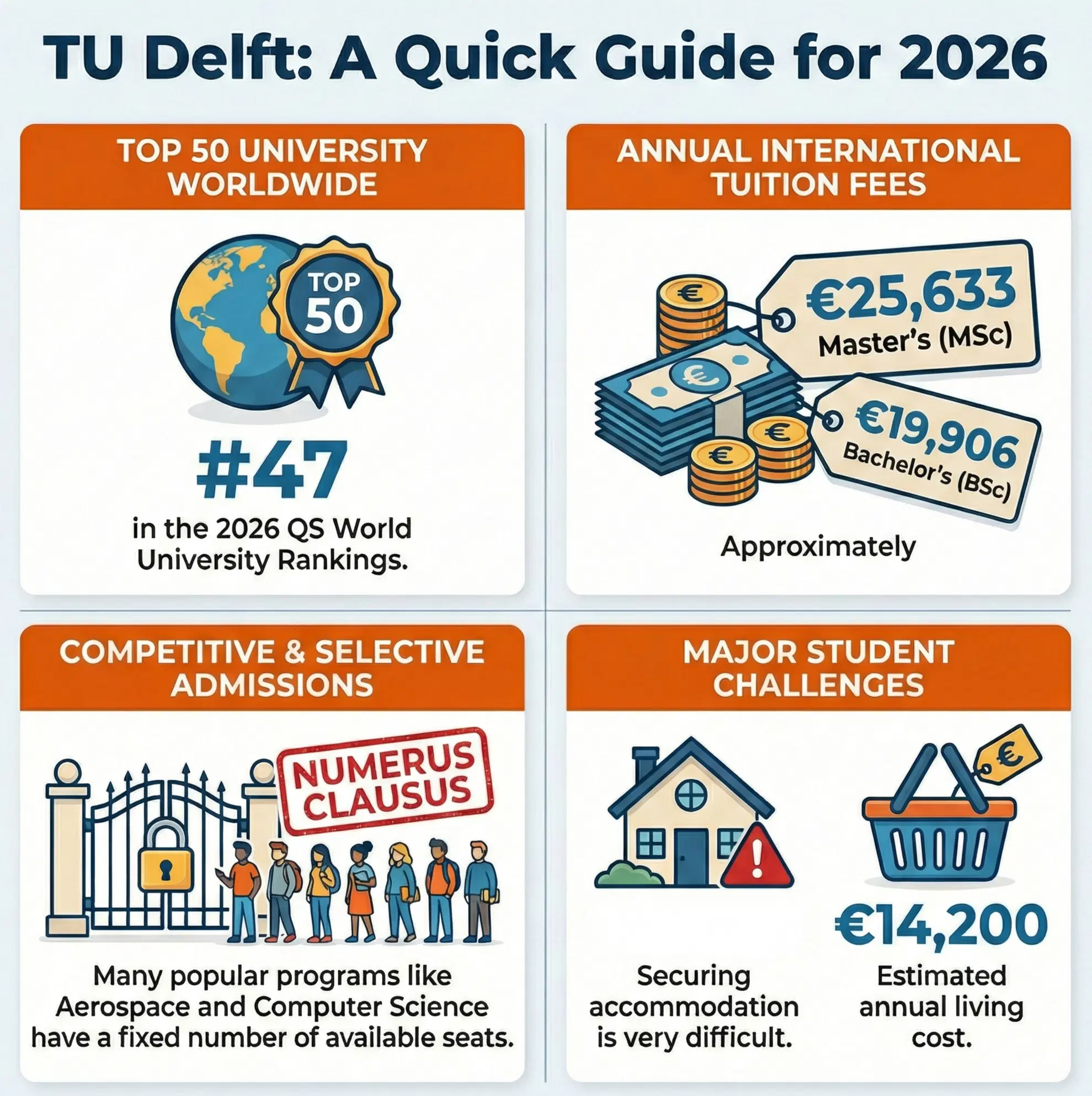
Established in 1842, Delft University of Technology (TU Delft) is a leading public technical university located in Delft, the Netherlands. It is the largest and oldest technical university in the country, with a student population of approximately 26,500 students (latest official figures as of Dec 2025). Nearly 29%+ of the student community is international, reflecting its strong global appeal. In the QS World University Rankings 2026, TU Delft ranks #47 globally, while THE World University Rankings 2026 places it among the global top 60 universities. Internationally recognized for its excellence in Engineering & Technology, TU Delft consistently ranks among Europe’s most prestigious institutions for technical education.
TU Delft matters for international students due to the following reasons:
| Particulars | Details |
|---|---|
| Type | Public technical university |
| Established | 1842 |
| Location | Delft, Netherlands (between Rotterdam and The Hague) |
| Campus Size | ~161 hectares (TU Delft Campus) |
| Student Enrollment | ~26,505 students (latest official) |
| International Students | ~28.4% of the student body (official) |
| Popular Courses | MSc courses in Data Science, Architecture, Urbanism & Building Sciences, Computer Science |
| Annual Tuition | - BSc: 19,906 EUR (21.70 lakhs INR) - MSc: 25,633 EUR (27.95 lakhs INR) |
Currency conversion used: 1 EUR= 107.14 INR as of March 3, 2026
TU Delft is consistently ranked among the top engineering universities globally. It maintains national leadership and strong subject performance, especially in engineering, civil, and architecture disciplines.
Here’s how Delft University of Technology ranks in the most recognized global university tables for the latest cycles:
TU Delft’s technical excellence shows strongly in subject-focused rankings, especially in core engineering domains. Visit TU Delft rankings to know more.
From aerospace engineering to architecture, TU Delft offers a wide range of undergraduate and postgraduate programs across eight faculties. Its curriculum emphasizes practical learning, research, and innovation.
Most of the full-time MSc courses at TU Delft are 2 years long and start in September. As an Indian student (non-EU/EEA), you will pay the institutional tuition fee of 25,633 EUR (27.57 lakhs INR) for MSc programs, which is uniform across most programs. All programs are taught in English and require English proficiency from Indian students, as demonstrated by IELTS 7.0 or TOEFL 100.
Entry requirements of a few popular MSc courses at TU Delft are tabulated below:
| Program | Entry Requirements | Tips for Indian Students |
|---|---|---|
| MSc Data Science and Technology | - Relevant BSc degree (e.g., Computer Science, Engineering, Math) with a minimum of 75% | - Popular choice - Focus on programming & AI experience in the motivation letter |
| MSc Architecture, Urbanism and Building Sciences | - Relevant BSc in Architecture/Design/Built Environment with 75% | - A digital portfolio is crucial. Prepare strong design work samples |
| MSc Computer Science | - BSc in computer science or related with 75% - Solid programming & algorithms knowledge |
- Highly competitive course - Highlight projects/internships in the motivation letter to stand out |
| MSc Mechanical Engineering | - BSc in Mechanical/related engineering with 75% | - Diverse program, good for research-focused students |
| MSc Aerospace Engineering | - BSc degree in Aerospace/Mechanical with 75%+ - Strong physics/math background preferred |
- Competitive course - Apply by Dec 1 for scholarship consideration |
| MSc Civil Engineering | - BSc in Civil/Structural with 75% | - Focus on infrastructure/sustainability in the motivation letter |
| MSc Construction Management and Engineering | - BSc in Civil/Construction/Engineering with 75% | - Good for students looking for a management + engineering blend |
| MSc Robotics | - BSc in Robotics/Mechatronics/Comp Sc/Electrical Eng with 75%+ - Strong programming & control systems knowledge |
- Emerging field - Highlight robotics projects (if any) in the motivation letter |
The bachelor’s courses at TU Delft are 3 years long and start in September. Unlike MSc courses, BSc courses are taught in both Dutch and English, with some courses taught solely in Dutch.
| Program | Entry Requirements | Numerus Clausus / Selection? | Tips for Indian Students |
|---|---|---|---|
| BSc Computer Science and Engineering | - Indian 12th (CBSE/ICSE/State) with 75% overall - Strong Math & Physics/Chemistry/Computer Science |
Yes | - Extremely competitive - Highlight coding projects, Olympiads, or internships.- Strong math/programming background is essential |
| BSc Aerospace Engineering | - 12th with high scores in Math & Physics | Yes- Strict numerus clausus (440 places for 2026-2027) | - One of the most prestigious & competitive BScs worldwide - Prepare for selection (academic aptitude test, essays) - Strong JEE-level preparation might help |
| BSc Applied Earth Sciences | - 12th with Math, Physics, Chemistry with 75%+ | - No (admission based on meeting requirements) | - Focuses on geology, environment, energy, & sustainability in SOP - Good for students interested in the climate/tech intersection. |
| BSc Nanobiology | - 12th with strong Biology, Chemistry, Math/Physics with 75% | - No (direct admission if requirements are met) | - Joint program with Erasmus University Rotterdam (Erasmus MC) - Ideal if you like biotech/nanotech - Prepare strong motivation for nano-bio. |
*Dutch proficiency: If you do not know Dutch, you must complete TU Delft’s one-year Dutch preparatory course. With limited knowledge of Dutch, you must take a placement test to determine which language courses are required. With advanced Dutch (B2 or higher), you must pass a language assessment. Applicants with specific Dutch-taught secondary diplomas (such as IB with Dutch A or European Baccalaureate with Dutch) are considered to meet the language requirement already.
Ques: What is Numerus Clausus (NC)?
Ans: At TU Delft, numerus clausus refers to a government-approved cap on the number of students who can be admitted to certain high-demand Bachelor’s programs. Instead of offering admission to all qualified applicants, TU Delft limits intake to a fixed number of seats and uses a competitive selection process to rank applicants. Applicants must participate in TU Delft’s selection procedure (which includes online tests, assignments, or assessments), and students are admitted based on ranking until all seats are filled.
TU Delft’s primary intake for both BSc and MSc programs is September, with applications opening in mid-October of the previous year. Classes for the first semester start in the first week of September for both study levels.
To apply to TU Delft for the September 2026 intake, all applicants must use the national Dutch university portal, Studielink, for their initial registration. After registering in Studielink, applicants complete their submission by uploading documents through TU Delft’s own application systems (Osiaan/online portal).
| Category | Key Requirements for Indian Students |
|---|---|
| Bachelor’s (BSc) | - Class 12 must be equivalent to Dutch VWO (pre-university level) - Many programs are numerus clausus (limited seats) with a selection process. |
| Master’s (MSc) | - Must have a relevant Bachelor’s degree from a recognised university - Degree must closely match the TU Delft program content - Some programs may require GRE or other additional tests. |
| English Language | IELTS or TOEFL required if prior education was not fully in English. Minimum scores are program-specific. |
| Key Documents | Academic transcripts and certificates, CV, motivation letter, proof of English, passport, and digital portfolio (for design/architecture programs). |
To know more about requirements, course-specific deadlines, visit TU Delft admissions 2026.
Reddit Discussions about TU Delft Admissions:
Admissions are seen as straightforward if you meet the requirements, but highly competitive for numerus fixus bachelor’s programs like Aerospace Engineering and Computer Science. Many international students, including those from India and Asia, discuss GPA cut-offs, early applications, and the need to apply early for housing. Check out the general application deadlines for the Netherlands for a clear picture.
In this video, the speaker is talking about the academic, social & financial fit of the university, including admission requirements and useful application tips.
The cost of living in Delft for international students is moderate compared to other major Dutch cities like Amsterdam. However, housing remains the biggest expense due to high demand and limited supply. According to the official website of TU Delft, the annual cost of living is estimated at 14,200 EUR (15.27 lakhs INR).
An estimated breakdown of monthly living costs for international students in Delft is as follows:
| Category | Estimated Monthly Cost | Estimated Monthly Cost (INR) |
|---|---|---|
| Accommodation (Rent) | €500 - €1,350 | 52,500- 1.41 lakhs |
| Food / Groceries | €200 - €350 | 21,000- 36,750 |
| Health Insurance | €100 - €130 | 10,500- 13,650 |
| Transport | €50 - €100 | 5,250- 10,500 |
| Books / Study Materials | €30 - €70 | 3,150- 7,350 |
| Mobile / Internet | €20 - €40 | 2,100- 4,200 |
| Leisure / Personal / Miscellaneous | €100 - €200 | 10,500- 21,000 |
| Total Monthly Estimate | €900 - €1,300 | 94,500- 1.36 lakhs |
Student discussions on public forums such as Reddit suggest that securing accommodation at TU Delft is very difficult for international students due to the housing crisis in the Netherlands. TU Delft’s housing service is considered the most reliable option, but it is limited, not guaranteed, and fills up quickly. Many students have to live in nearby cities like The Hague or Rotterdam and commute. High rent, scams, and temporary housing are common concerns.
TU Delft offers very limited scholarships for international students. MSc applicants are eligible for an excellence scholarship and faculty-specific scholarships (Applied Sciences, Electrical Engineering, Mathematics, and Computer Science).
| Scholarship | Award Value | Eligibility | Applicable Programs |
|---|---|---|---|
| Faculty Scholarship (Microelectronics) | Full tuition fees | International students with at least 80% marks in their bachelor’s from a recognized non-Dutch university. Must be (conditionally) admitted to the MSc in Electrical Engineering (Microelectronics). | MSc Electrical Engineering (Track: Microelectronics) |
| QuTech Scholarship | Full tuition fees | International students with at least 80% GPA in their bachelor’s from a recognized non-Dutch university. Must be (conditionally) admitted to specific MSc programs. | MSc in Quantum Information, Applied Physics, Computer Science, Electrical Engineering, Computer Engineering, or Embedded Systems |
| Justus & Louise van Effen Excellence Scholarships | Full tuition fees per year for a TU Delft MSc course + living expenses | Excellent international applicants, conditionally admitted to one of the 2-year regular TU Delft MSc programs | All programs except the International Joint Education |
Note: International undergraduate students may be eligible for a study grant while studying at TU Delft. Contact your respective academic department for more information. Visit the scholarships in the Netherlands for external scholarships.
The TU Delft Campus is a vibrant, innovation-driven environment that blends education, research, entrepreneurship, and community living. It has modern academic buildings, shared workspaces, green outdoor areas, cafes, and facilities. The Stevin area on campus is a key hub with student housing, teaching spaces, supermarkets & cafés. Additionally, TU Delft has:
A quick comparison between TU Delft and other Dutch universities is given below:
| Feature | TU Delft | Eindhoven University of Technology | University of Amsterdam |
|---|---|---|---|
| Type | Public Technical University | Public Technical University | Public Research University |
| Established | 1842 | 1956 (technical roots 1912) | 1632 |
| QS World Ranking 2026 | #47 | #140 | #53 |
| THE World Ranking 2026 | #57 | #192 | #62 |
| Core Strength | Engineering & Technology | Engineering, Applied Sciences | Social Sciences, Business, Humanities, AI |
| Industry Focus | Strong European tech ecosystem | Strong high-tech & semiconductor ecosystem | Strong corporate & finance ecosystem (Amsterdam hub) |
| Research Intensity | Very High (STEM-focused) | High (Tech-focused) | Very High (Broad disciplines) |
| Best For | Aerospace, Civil, Robotics, Sustainable Tech | Embedded Systems, Automotive, Data Science | Economics, Psychology, AI, Communication |
Interpretation:
From an academic standpoint, TU Delft’s strength lies in research intensity, selective admissions (especially numerus clausus programs), and strong STEM specialization. Programs such as Aerospace Engineering, Computer Science, Robotics, and Civil Engineering attract top-tier applicants, including Indian students.
Financially, tuition (EUR 25,633 for MSc) plus living costs (~EUR 14,200 annually) make TU Delft a premium European study option among the higher tuition public universities in the Netherlands for non-EU students. Though still more affordable than comparable US or UK engineering schools. However, scholarships are limited and highly competitive, meaning most students should be financially prepared.
Ques: Is TU Delft hard to get into?
Ans: Yes, TU Delft is competitive, especially for numerus clausus programs like Aerospace Engineering and Computer Science. Admission is straightforward if you fully meet academic and subject prerequisites, but selection-based bachelor’s programs and popular MSc courses attract strong international applicants, making competition high for limited seats.
Ques: What GPA is required for TU Delft?
Ans: For most MSc programs, Indian students are expected to have at least 75% or equivalent in a relevant bachelor’s degree. Highly competitive programs (e.g., Aerospace, Robotics, Computer Science) often require strong subject alignment and academic consistency beyond the minimum threshold.
Ques: Is IELTS mandatory?
Ans: Yes, IELTS or TOEFL is generally mandatory if prior education was not entirely in English. Most MSc programs require IELTS 7.0 or TOEFL iBT 100, while English-taught BSc programs require IELTS 6.5 or TOEFL 90. Requirements may vary slightly by program.
Ques: What is the tuition fee?
Ans: For non-EU students (including Indians), tuition is approximately €19,906 per year for BSc and €25,633 per year for MSc programs. Living expenses are estimated at around €14,200 annually, making total yearly costs roughly €34,000–€40,000 depending on lifestyle.
Ques: Is Delft good for Computer Science?
Ans: Yes. TU Delft is globally recognized for Engineering & Technology and offers a strong MSc in Computer Science. The program is competitive, research-driven, and closely aligned with AI, data science, and systems engineering, with strong links to the European tech ecosystem.
Ques: Does TU Delft offer scholarships for Indians?
Ans: Yes, but scholarships are limited and highly competitive. Indian students can apply for the Justus & Louise van Effen Excellence Scholarship, faculty-specific awards (e.g., Microelectronics), and select research-based scholarships. Most awards cover full tuition, sometimes with living support.
Explore tuition, duration, language, eligibility, and exam requirements without the clutter.
Courses
41
Fee from
₹22,00,290.9
Exams
TOEFL · IELTS
Showing 4 bachelors
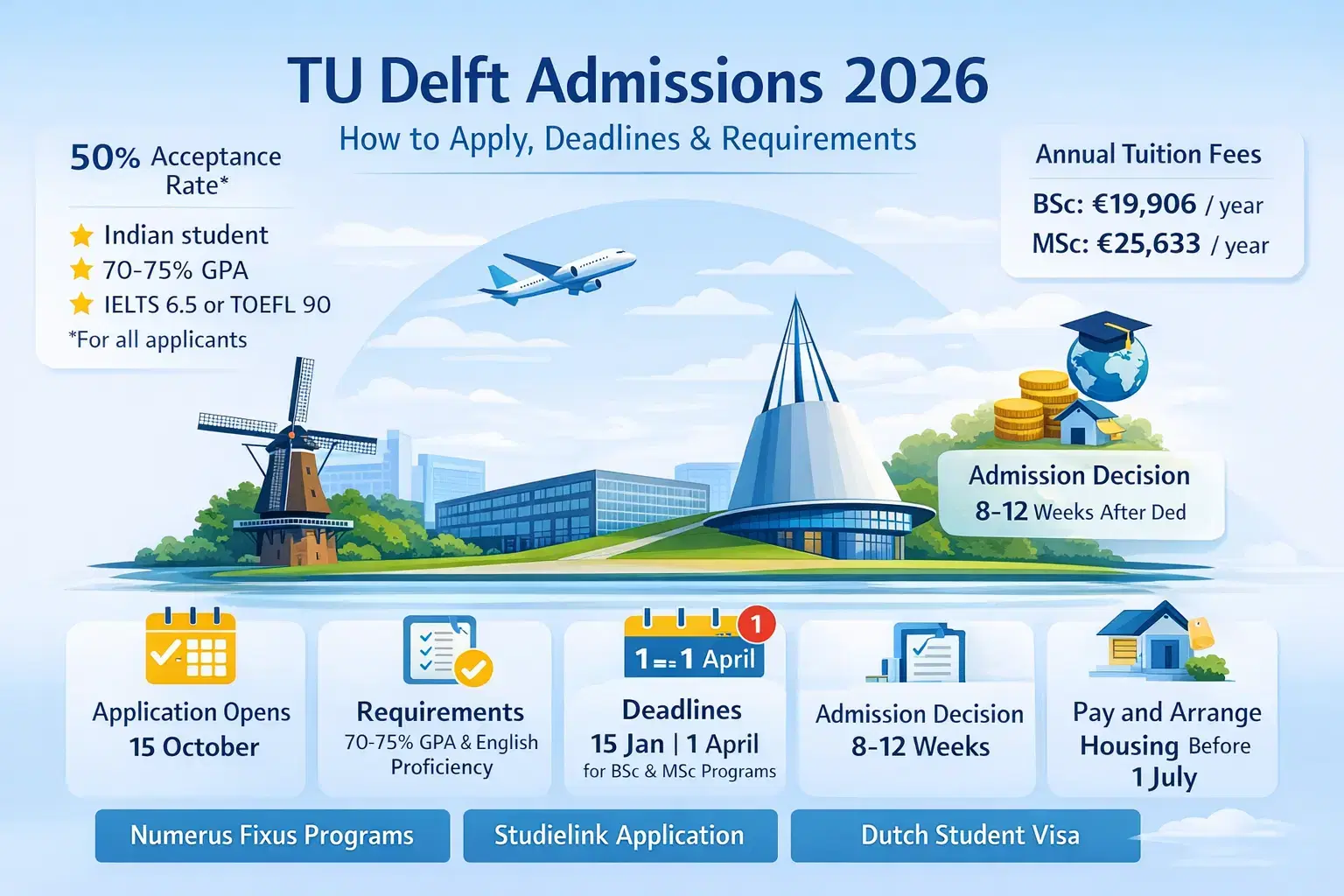
Delft University of Technology (TU Delft) offers the September intake only as the main entry point for international students. As one of Europe’s leading technical universities, TU Delft is academically competitive for high-demand engineering and technology courses. Key deadlines for 2026 admissions include:
Academic requirements at TU Delft differ by level and program. Indian undergraduate applicants must hold a Class 12 qualification with a minimum of 75% from CBSE/ CISCE boards. Master’s applicants require a relevant Bachelor’s degree with 75% or higher, along with program-specific documents such as motivation letters, references, portfolios, and, for some courses, GRE scores.
1.1 TU Delft MSc Application Timeline
1.2 TU Delft BSc Application Timeline
2.1 TU Delft Master's Admissions Requirements
2.2 TU Delft Bachelor’s Admission Requirements
3.1 Delft University of Technology Admission Decision
Every year, TU Delft starts accepting completed applications from mid-October for the following September intake. This applies to all BSc and MSc courses. Application timelines for different study levels are as follows:
The following timeline applies to all MSc courses offered by TU Delft.
| Event | Date |
|---|---|
| Application opens | 15 October |
Application deadline for the following MSc courses
|
15 January |
| Application deadline for other MSc courses | 1 April |
| Offer confirmation deadline | 1 June |
| Full payment deadline | 1 July |
| Start of academic year | 1 September |
| Start of the first semester | 1st week of September |
The following timeline applies to regular BSc courses at TU Delft.
| Event | Date |
|---|---|
| Application opens | 15 October |
| Application & document deadline | 1 April |
| Offer confirmation deadline | 1 June |
| Full payment deadline | 1 July |
| Start of the first semester | 1st week of September |
TU Delft has categorized BSc courses as regular and numerus clausus (NC) programs. Numerus clausus refers to a government-approved limit on the number of students who can be admitted to certain high-demand Bachelor’s programs. These are:
The application deadline for the above NC programs is 15 January; other timelines remain the same.
Know more: Application deadlines in Netherlands
Delft University of Technology (TU Delft) requires international applicants to hold a secondary school certificate equivalent to the Dutch VWO diploma (often with high grades in math/physics) for bachelor's. For master's, a relevant Bachelor’s degree is required. Language proficiency requirement depends on the chosen program:
| Particulars | Bachelors | Masters |
|---|---|---|
| Application portal | Studielink | Studielink |
| TU Delft application fee | 100 EUR (10,995 INR) | 100 EUR (10,995 INR) |
| Academic eligibility | - Class 12 certificate from CISCE/ CBSE boards with 75% - Students from other boards are not eligible |
Bachelor’s degree with 75% marks |
| Application requirements | - High school certificate copy - Academic transcript - English language certificate - CV in English - Passport copy |
- Bachelor’s degree certificate - Academic transcript - English language certificate - Passport copy - Motivation letter - CV - Reference - Portfolio - GRE (for some courses) |
| Language proficiency | - IELTS 6.5 - TOEFL iBT 100 - Dutch proficiency B2 level |
- TOEFL iBT: 100 - IELTS: 7.0 |
Note: For bachelor’s courses taught in English, IELTS 6.5 or TOEFL iBT 100 is required. Bachelor’s courses taught in Dutch require both English and Dutch proficiency. In those cases, English proficiency requirements are IELTS 5.5/ TOEFL iBT 70.
For the 2026-27 session, the annual tuition fees for master's courses are 25,633 EUR (28.18 lakhs INR). Admission requirements of a few popular master's courses at TU Delft are as follows:
| Course | Admission Requirements |
|---|---|
| MSc Data Science and Technology | - Relevant BSc degree (e.g., Computer Science, Engineering, Math) with a minimum of 75% - Recommended GRE score: 154 in Verbal Reasoning, 163 in Quantitative Reasoning, and 4.0 in Analytical Writing |
| MSc Architecture, Urbanism and Building Sciences | - Relevant BSc in Architecture/Design/Built Environment with 75% |
| MSc Computer Science | - BSc in computer science or related with 75%- Solid programming & algorithms knowledge - Mandatory GRE score: 154 in Verbal Reasoning, 163 in Quantitative Reasoning, and 4.0 in Analytical Writing |
| MSc Mechanical Engineering | - BSc in Mechanical/related engineering with 75% |
| MSc Aerospace Engineering | - BSc degree in Aerospace/Mechanical with 75%+ - Strong physics/math background preferred - Recommended GRE score: 154 in Verbal Reasoning, 163 in Quantitative Reasoning, and 4.0 in Analytical Writing |
| MSc Civil Engineering | - BSc in Civil/Structural with 75% |
| MSc Construction Management and Engineering | - BSc in Civil/Construction/Engineering with 75% |
| MSc Robotics | - BSc in Robotics/Mechatronics/Comp Sc/Electrical Eng with 75%+ - Strong programming & control systems knowledge |
Annual tuition fees for the bachelor’s courses at TU Delft are 19,906 EUR (21.88 lakhs INR) for the 2026-27 session.
| Program | Entry Requirements |
|---|---|
| BSc Computer Science and Engineering | - Indian 12th (CBSE/CISCE) with 75% overall - Strong Math & Physics/Chemistry/Computer Science |
| BSc Aerospace Engineering | - Overall 75% marks in 12th with high scores in Math & Physics |
| BSc Applied Earth Sciences | - 12th with Math, Physics, Chemistry with 75%+ |
| BSc Nanobiology | - 12th with strong Biology, Chemistry, Math/Physics with 75% |
Here’s how Indian students can apply to TU Delft using Studielink:
Step 1: Check eligibility:
Step 2: Register on Studielink:
Step 3: Activate NetID:
Step 4: Complete TU Delft application:
Step 5: Selection (for Numerus Clausus BSc only):
Step 6: Admission decision:
Step 7: Accept offer & arrange visa/fees:
According to Reddit Reviews, here are the key points Indian students must consider:
At TU Delft, the admission decision timeline varies depending on the chosen program.
TU Delft does not publish any official data on acceptance rate. Some websites cite that the acceptance rate is around 82%. That means admission to TU Delft is lightly competitive, providing a fair chance to eligible Indian students. It is advised that you should apply well in advance and ensure all required documents are submitted before the deadline for timely evaluation.
Ques: What GPA/percentage do I need to get into TU Delft?
Ans: For most programs, you need strong grades. Indian students usually need around 75% or higher. For competitive courses (like Aerospace, CS, CSE), you may need even higher marks. However, meeting the minimum does not guarantee admission.
Ques: What is Numerus Clausus, and how does it affect admission?
Ans: Numerus Clausus (NC) means the program has limited seats and applies to bachelor’s courses only. Applicants for NC programs are ranked (based on an online exam, academic aptitude tests, and/or questionnaires), and only top-ranked students get offers. Popular NC programs include BSc Aerospace Engineering and BSc Computer Science & Engineering.
Ques: How long does TU Delft take to give admission decisions?
Ans: It varies depending on the study level:
Ques: Is work experience required for MSc admission at TU Delft?
Ans: Work experience is not required for most MSc programs. However, good internships, projects, or research can help your application. While strong academics are still the most important factor.
Ques: Is housing guaranteed for international students at TU Delft?
Ans: Housing is not guaranteed for all students. TU Delft helps some first-year UG international students, but places are limited. Many students need to find private housing and should start early.
Delft University of Technology in Delft, South Holland, Netherlands placement details include salary insights, top recruiters, and hiring trends to help students understand career outcomes and campus opportunities.
Students usually compare highest package, average package, and recruiter profile before applying. This section gives a compact overview of career outcomes and placement visibility in Delft, South Holland, Netherlands.
Represents the top salary package reported in the available placement information.
Shows the typical package range students may expect based on the available average salary data.
Placement information is currently limited.
More salary or recruiter data may be updated later for this college.
Year-wise highlights from global and country rankings available for this university.
Overall sentiment and category-wise rating summary
Overall score
Based on 6 ratings
Visual summary of rating distribution and categories