
Placement Metric
Highest Package
N/A
Represents the top salary package reported in the available placement information.

Explore overview, courses, fees, admissions, campus life, scholarships and student accommodation guidance in one premium Admistay guide.
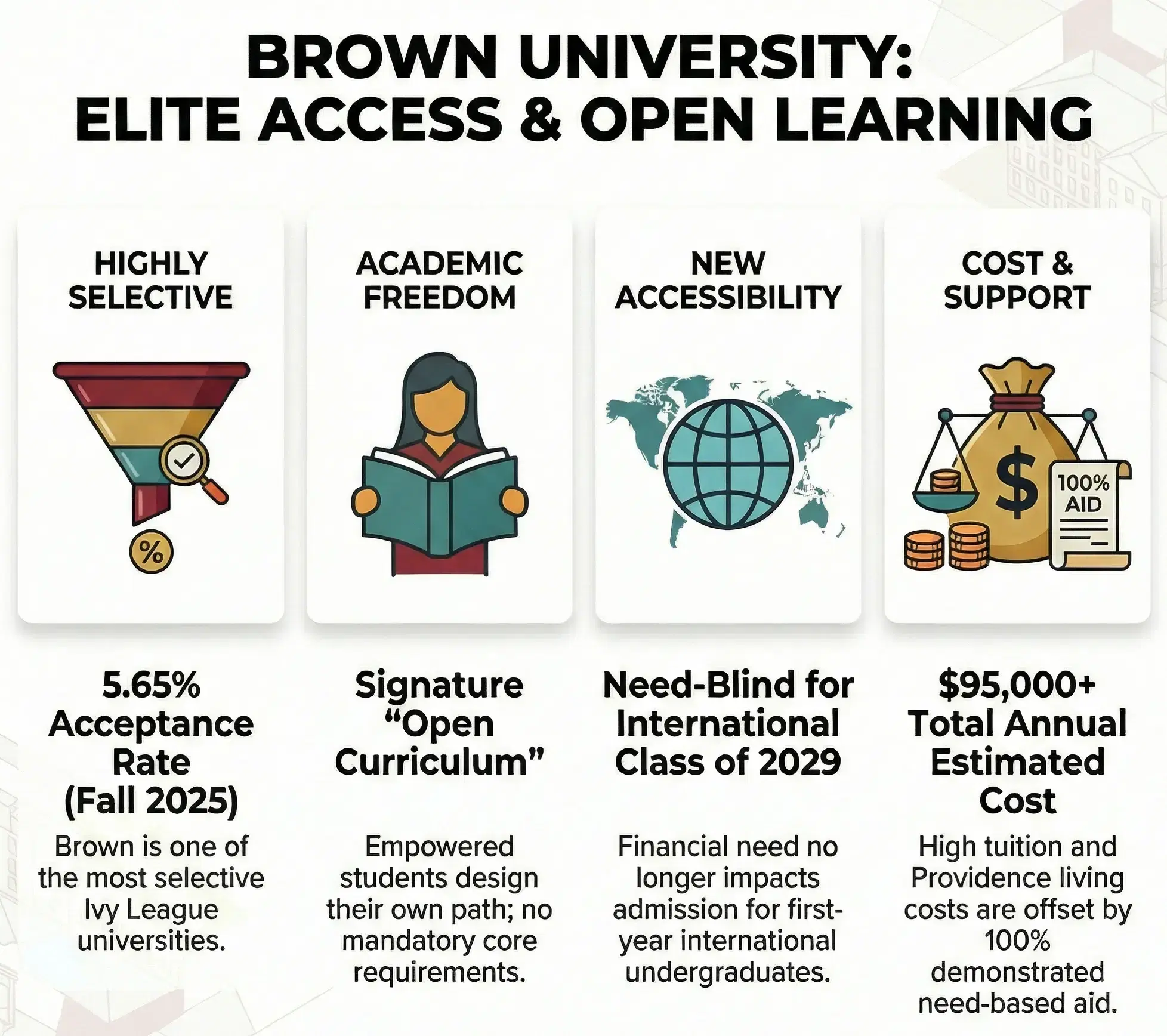
With an acceptance rate of just 5.65 % for the Class of 2029 (Fall 2025 entry), Brown University stands firmly in the top tier of Ivy League selectivity. This private Ivy League university is located in the historic College Hill area of Providence, Rhode Island. Unlike traditional core-curriculum Ivy League schools, Brown’s unique Open Curriculum empowers undergraduates to shape their own academic pathway. In global rankings, Brown stands as a top 70 university as per QS and THE rankings 2026.
Brown University’s academically intense environment features a 6:1 student-faculty ratio. For Indian students, Brown is especially popular for programs such as MS Computer Science, MS Data Science, and MS Biotechnology. Being a private-Ivy, Brown’s tuition fees are on the higher side. Brown follows a standard tuition structure for undergraduate and PhD programs (74,568 USD/ 67.80 lakhs INR). Most master’s programs use a per-course fee model, leading to varying annual costs. Brown primarily admits undergraduate students in the Fall intake, with multiple intakes offered for graduate programs.
Currency conversion used: 1 USD= 90.93 INR as of February 25, 2026
Choosing Brown University in 2026 means committing to an Ivy League experience that prioritizes academic freedom, personalized intellectual exploration, and meaningful research engagement.
Brown’s Open Curriculum at the undergraduate level is one of the most flexible in the world. This allows students to:
Brown’s has a strong research footprint, with over $1.2 billion in federal research funding and more than 4,000 research awards recorded between 2020 and 2024. Whether through Advanced Undergraduate Research Fellowships, summer projects, or faculty-led labs, undergraduates have direct access to original research opportunities.
Brown students benefit from a cross-registration agreement with the nearby Rhode Island School of Design (RISD), one of the premier art and design colleges in USA.
While other Ivys, such as Harvard and Yale, also provide world-class academics and research infrastructure, Brown’s philosophy centers on student-led learning and curricular autonomy.
| Feature | Brown University | Harvard University | Yale University |
|---|---|---|---|
| Open Curriculum (no core requirements) | Full Open Curriculum | Requires general education + distribution requirements | Requires distribution requirements |
| Undergraduate Research Access | Highly accessible, often early in the degree | Strong but structured; competitive entry into labs | Strong research culture with formal program pathways |
| RISD Cross-Registration | Available by agreement | No equivalent art/design partner | No equivalent art/design partner |
Note: All three are elite research universities, but Brown’s model prioritizes flexibility and exploration more than the core/distribution-based models at Harvard and Yale. Visit Ivy League Universities in USA for more information.
Brown University consistently ranks among the world’s top academic institutions, reflecting both its research output and undergraduate academic model.
More details on subject-specific rankings and year-on-year trends can be found in Brown University rankings.
Brown University offers master’s programs in on-campus, online, and hybrid modes via the Graduate School. The master’s programs at Brown University follow a per-course fee structure, meaning every program has different tuition fees based on its minimum annual course requirements. To know more, visit Brown University master’s fees.
Check out the annual tuition fees and admission requirements of a few popular master’s programs of Brown University in the following table.
| Program | Annual Tuition Fee (USD/ INR) | Eligibility | Application Deadline | Notes for Indian Students |
|---|---|---|---|---|
| MS Computer Science | 43,908 (39.92 lakhs) | Undergraduate degree in Computer Science | Closed for 2026 | - GRE not required, but encouraged - A strong Computer Science/ Math background is expected. |
| MS Data Science | 40,784 (37.08 lakhs) | Undergraduate degree in a related field | Closed for 2026 | - Must have calculus and linear algebra knowledge - Programming experience is helpful. |
| MS Biotechnology | 37,280 (33.89 lakhs) | Undergraduate degree in a science field | April 15, 2026 | - Biology, neuroscience, biochemistry, physics, or chemistry undergraduate degree preferred |
| MS Innovation Management and Entrepreneurship | 74,560 (67.79 lakhs) | Undergraduate degree | Closed for 2026 | - STEM course with an entrepreneurship focus - 2 Video essays are required for admission |
| MS Physics | 81,960 (74.52 lakhs) | Strong background in Physics or closely related subjects at the undergraduate level | April 1, 2026 | - GRE is recommended, but not required - 2 LORs are required - Apply at least 3 months before for a smooth visa process |
| MS Electrical and Computer Engineering | 40,892 (37.18 lakhs) | Undergraduate degree in a related field | April 1, 2026 | - GRE not required, but recommended |
| MS Medical Sciences | 75,162 (68.34 lakhs) | Undergraduate degree | May 15, 2026 | - MCAT score - Zoom interview - Limited class size, apply early |
| MS Biomedical Engineering | 37,280 (33.89 lakhs) | Undergraduate degree | April 15, 2026 | - Mix of engineering/ biomedical program - Multiple degree options available (MS, MEng) |
| MS Biostatistics | 52,476 (47.71 lakhs) | Undergraduate degree | Closed for Fall 2026 | - Must have a strong mathematical background (calculus, linear algebra, probability) |
| MA Design Engineering (MADE) | 90,662 (82.43 lakhs) | Undergraduate degree | Closed for Fall 2026 | - Dual degree by Brown & RISD (Rhode Island School of Design) - A digital portfolio is required |
Note: Indian students must have a GPA of 3.0 on a 4.0 (75% for Indian students) scale to be eligible for the above programs. Additionally, they must also submit an international transcript evaluation (WES, ECE, or The Evaluation Company). Read WES Evaluation to know more.
Brown University offers undergraduate programs through its ‘The College’. Students can choose to study from more than 80 academic concentrations at the undergraduate level. Brown University has a standard tuition rate for all undergraduate programs. For 2026-27, the tuition fees are:
Students with a high school diploma or equivalent can apply to the undergraduate programs at Brown University.
Brown University generally has one primary annual undergraduate intake for the Fall semester, with students admitted through two main cycles: Early Decision and Regular Decision. Graduate programs (MS, MA, PhD, online master’s, professional master’s) may have multiple intakes throughout the year, depending on the program.
| Requirement | Undergraduate (UG) | Master’s / Graduate (PG) |
|---|---|---|
| English Proficiency | Required if schooling was not fully in English. Accepted tests & minimum scores: IELTS: 8.0 - TOEFL: 105 - DET: 130 - PTE: 75 |
TOEFL or IELTS is required if the degree was not fully in English. Minimum accepted scores are: -TOEFL: 90 - IELTS: 7.0 |
| Academic Records | Class 9–12 transcripts + Class 10 & 12 board results (CBSE/ISC/State Boards). Predicted scores are accepted if final results are pending. |
University transcripts required. Unofficial at application; official after admission. 3-year Indian bachelor’s degrees are accepted. |
| *Standardized Tests | SAT/ACT as per current Brown policy. | GRE/GMAT depends on the program; many do not require it. |
| Application Portal | Common Application + Brown supplement, essays, recommendations. | Brown Graduate School or program-specific portal + SOP, recommendations, CV. |
*Note: Brown University does not have any minimum requirement for the standardized test. This is due to Brown’s holistic approach, where scores are just components, rather than requirements. For more information on requirements and deadlines, visit Brown University admissions.
Brown University remains one of the most selective institutions in the Ivy League, with single-digit acceptance rates and an increasingly competitive applicant pool. According to Brown University’s Common Data Sets (2025, 2024, and 2023), a 3-year acceptance rate trend is given below:
| Intake | Total Applicants | Accepted Applicants | Acceptance Rate |
|---|---|---|---|
| Fall 2025 | 42,765 | 2,418 | 5.65% |
| Fall 2024 | 48,904 | 2,638 | 5.39% |
| Fall 2023 | 51,316 | 2,686 | 5.23% |
Trend:
- Acceptance rates remain below 6% across all cycles, confirming extreme selectivity.
- The slight rise to 5.65% in Fall 2025 reflects fewer applicants, not easier admissions.
For more information on class profile, Early Decision vs Regular Decision rate, and international acceptance insight, visit Brown University acceptance rate.
In this video, the speaker is talking about Brown’s history, campus life, academic environment, financial considerations, and detailed admission advice.
Unlike larger Ivy League campuses, Brown offers a more intimate environment. Brown operates a residential community model where nearly all first-year students live on campus.
Brown has 400+ student organizations, spanning:
Brown maintains its own Department of Public Safety and reports crime statistics annually under the Clery Act. Violent crime rates are relatively low and comparable to those of peer Ivy League campuses. Security features include:
For international students from India, campus safety is considered strong relative to many large US urban universities.
Providence offers what many describe as the “best of both worlds.”
Travel time:
Compared to Boston (home to institutions like Harvard and MIT), Providence feels less crowded, more personal, and more affordable, while still offering internship access in the broader Northeast corridor.
Did you know? Anant Ambani, the youngest son of Nita and Mukesh Ambani, attended Brown University. He utilized Brown's open curriculum to gain a broad education, with a focus on business management, according to The Times of India.
According to student reviews on Reddit and Quora, the cost of living in the Providence area is considered moderate, especially compared to bigger cities like NYC or Boston, but still high for students. As per numbers published by Brown University, the annual cost of living ranges from 21,334 USD to 48,000 USD (19.39 to 43.64 lakhs INR), depending on your level of education.
The estimated breakdown of the annual living expenses for undergraduate and graduate students at Brown University is given below.
| Particulars | Cost (USD/ INR) |
|---|---|
| Tuition | 74,568 USD (67.80 lakhs) |
| Housing | 10,710 USD (9.56 lakhs) |
| Food | 8,754 USD (7.45 lakhs) |
| Mandatory fees in addition to tuition | 3,084 USD (2.71 lakhs) |
| Personal expenses | 2,878 USD (2.59 lakhs) |
| Total | 99,994 USD (90.92 lakhs) |
| Expense Category | Estimated Annual Cost (USD/ INR) | Notes |
|---|---|---|
| Housing & Food | 26,667 - 35,556 USD (24.51 - 32.64 lakhs) | On-campus/off-campus average estimate |
| Books & Course Materials | 1,080 - 1,485 USD (99,280 - 1.36 lakhs) | Varies by program |
| Misc. Personal Expenses | 3,222 - 4,296 USD (2.96 - 3.94 lakhs) | Includes clothing, phone, and personal needs |
| Transportation | $1,008 - 1,344 USD (92,662 - 1.23 lakhs) | Local travel and limited long-distance |
| Health Insurance | 4,944 - 5,365 USD (4.54 - 4.93 lakhs) | Mandatory, unless waived with an approved plan |
| Mandatory University Fees | 336 - 1,536 USD (30,887 - 1.41 lakhs) | Includes: Health Services, Recreation, Activities, Records |
Reddit discussions on Brown University’s cost of living housing in Providence, Rhode Island:
Brown University offers financial support to international students primarily through need-based institutional aid for undergraduates and guaranteed funding packages for doctoral (PhD) students. Brown's undergraduate financial aid is need-based only; no merit scholarships are available.
For graduate students, incoming PhD students receive a multi-year funding guarantee that includes stipends, tuition remission, and health insurance subsidies. Master's programs are largely self-funded, with no central university scholarships or guaranteed aid.
International students can check the external scholarships for the USA and apply to a suitable one.
Did you know? Starting with applicants entering in fall 2025 (Class of 2029), Brown is need-blind for first-year international undergraduates, meaning financial need does not affect admission decisions. Moreover, the university meets 100% of demonstrated need for admitted students who apply for aid, using grants (not loans) to cover costs like tuition, fees, room, board, books, travel, and personal expenses.
Brown University delivers strong post-graduation outcomes, combining Ivy League brand equity with a flexible academic model. As per Brown’s latest reported data:
For Indian students evaluating ROI, this salary range significantly offsets total cost of attendance, especially when entering high-demand sectors like tech, consulting, finance, and healthcare.
Brown University stands out as a highly selective Ivy League institution offering world-class academics, flexible learning through its Open Curriculum, and strong global recognition. For Indian students, it provides excellent opportunities across STEM, data, and interdisciplinary programs, but comes with a high cost of attendance and intense competition.
Ques: How competitive is admission to Brown University? Can Indian students realistically get in?
Ans: Brown University is extremely competitive, with an acceptance rate of about 5.65%. Indian students who get admitted usually have very strong academics, top grades in Class 10 and 12, challenging coursework, and strong extracurriculars. Test scores are optional, but admitted students often have very high SAT/ACT or GRE scores. Beyond marks, Brown looks closely at essays, recommendations, and overall profile fit.
Ques: What is student life like at Brown University? Is it stressful?
Ans: Most students describe Brown as academically rigorous but flexible. Thanks to the Open Curriculum, students can choose what they study instead of following fixed core subjects. This reduces academic pressure for many students. Campus life is collaborative rather than cut-throat, and students say there is a good balance between studies, clubs, and social life.
Ques: Is Brown University too expensive? Is it worth the cost for Indian students?
Ans: Brown is very expensive, with total yearly costs often close to USD 90,000–97,000. For undergraduate Indian students, Brown offers strong need-based financial aid and is now need-blind, meaning money does not affect admission decisions. However, most master’s programs offer little or no financial aid, so Indian students must plan their finances carefully and consider return on investment before applying.
Ques: How is Brown University for international and Indian students?
Ans: Brown has a diverse and welcoming international community, including Indian students. Most international students say they feel well supported academically and socially. However, the high cost of living and limited funding for master’s students can be challenging. Students recommend planning housing early and budgeting carefully.
Ques: How important are interviews, essays, and application details at Brown?
Ans: They are very important. Brown follows a holistic admission process, meaning grades alone are not enough. Essays are used to understand your thinking style, interests, and fit with Brown’s Open Curriculum. Interviews (when offered) are informal and meant to know you better, not to test knowledge. Strong essays and clear motivation often make a big difference.
Explore tuition, duration, language, eligibility, and exam requirements without the clutter.
Courses
66
Fee from
₹39,44,631.9
Exams
IELTS · TOEFL
Showing 5 of 37 bachelors
With an acceptance rate of approximately 5.65% in the latest admission cycle, Brown University remains one of the most selective Ivy League institutions in the USA. Competition is intense across both Early Decision (ED) and Regular Decision (RD) rounds, making early preparation critical. For the 2026 entry cycle:
International students whose primary language of instruction is not English are typically required to submit proof of English proficiency, unless eligible for a waiver based on their schooling background. Besides the academic requirements, an international candidate is also required to submit certain important documents while applying to Brown University, such as:
Brown University offers Fall intake for undergraduate programs. Select graduate and professional master’s programs may offer additional Spring or Summer start terms.
Applications for Fall 2026 have concluded. The next intake (Fall 2027) opens in August 2026. International students can start applying for the fall 2027 entry from August 2026 to September 2026. The tentative application deadlines are:
Application Portal: Common App
Application Fee: 80 USD (7,274 INR)
Note: These tentative deadlines are based on last year’s deadlines. Though they remain the same each year, visit this page around June-July for the latest updates.
The application deadlines for professional master’s programs at Brown University are tabulated below.
Application portal: Professional Master’s Application Portal
Application Fee: 200 USD (18,185 INR)
| Program | Fall Deadline | Spring Deadline | Summer Deadline |
|---|---|---|---|
| MS Healthcare Leadership | May 1, 2026 | Not offered | Closed now |
| MS Technology Leadership | - Priority Deadline 1: December 1, 2025 (closed) - Priority Deadline 2: April 1, 2026 - Final Deadline: June 15, 2026 |
Not offered | Not offered |
| Executive MBA | No specific intake. Applications are reviewed on a rolling basis until February 15, 2026 | ||
The 2026 application deadlines for Brown’s online master's programs are as follows.
Application Portal: Program-specific
Application Fee: 100 USD (9,092 INR)
| Program | Fall Deadline | Spring Deadline | Summer Deadline |
|---|---|---|---|
| MS Biostatistics | - Early Action Deadline: March 15, 2026 - Priority Deadline: May 15, 2026 - Final Deadline: June 15, 2026 - Semester Starts: September 9, 2026 |
- Priority Deadline: September 15, 2026 - Final Deadline: October 15, 2026 - Semester Starts: January 27, 2027 |
Not offered |
| - MS Business Analytics - MS Data Science: Policy, Governance & Society - MS Management - MS Organizational Leadership |
- Early Action Deadline: March 15, 2026 - Priority Deadline: May 15, 2026 - Final Deadline: June 15, 2026 - Semester Starts: September 3, 2026 |
- Early Action Deadline: July 15, 2026 - Priority Deadline: September 15, 2026 - Final Deadline: October 15, 2026 - Semester Starts: January 27, 2027 |
Not offered |
| MS Public Health | - Early Action Deadline: March 15, 2026 - Priority Deadline: May 15, 2026 - Final Deadline: June 15, 2026 - Semester Starts: September 9, 2026 |
- Early Action Deadline: July 15, 2026 - Priority Deadline: September 15, 2026 - Final Deadline: October 15, 2026 - Semester Starts: January 27, 2027 |
- Priority Deadline: February 1, 2026 - Final Deadline: March 15, 2026 - Semester Starts: May 18, 2026 |
The application deadlines for Brown University’s master’s programs (other than professional & online) are as follows.
Application Portal: Program-specific
Application Fees: 75 USD (6,819 INR)
| Program | Fall Deadline | Spring Deadline |
|---|---|---|
| MS Biotechnology | April 15, 2026 | October 1, 2026 (tentative, based on last year) |
| MS Cybersecurity | April 15, 2026 | Not offered |
| MS Data-Enabled Computational Engineering and Science | April 1, 2026 | October 1, 2026 (tentative, based on last year) |
| MS Engineering (all disciplines) | April 1, 2026 | Not offered |
| MS Health Informatics | April 15, 2026 | October 1, 2026 (tentative, based on last year) |
| MS Medical Physics | March 1, 2026 | Not offered |
| MS Medical Sciences | May 15, 2026 | Not offered |
| MS Physics | April 1, 2026 | Not offered |
Important note:
Application deadlines for the following graduate programs are closed now for 2026 admission.
Biostatistics, Computer Science, Data Science, Design Engineering, MA Teaching, MA Urban Education, Innovation Management & Entrepreneurship, Public Affairs, Public Health, Accelerated Public Health, Public Health & Public Affairs Dual degree, Public Humanities, Social Data Analytics.
For more updated information on intakes, application timelines & deadlines, visit US university application deadlines 2026.
Brown University communicates admissions decisions through the secure Brown Applicant Portal (accessible after submitting your application). The timeline varies:
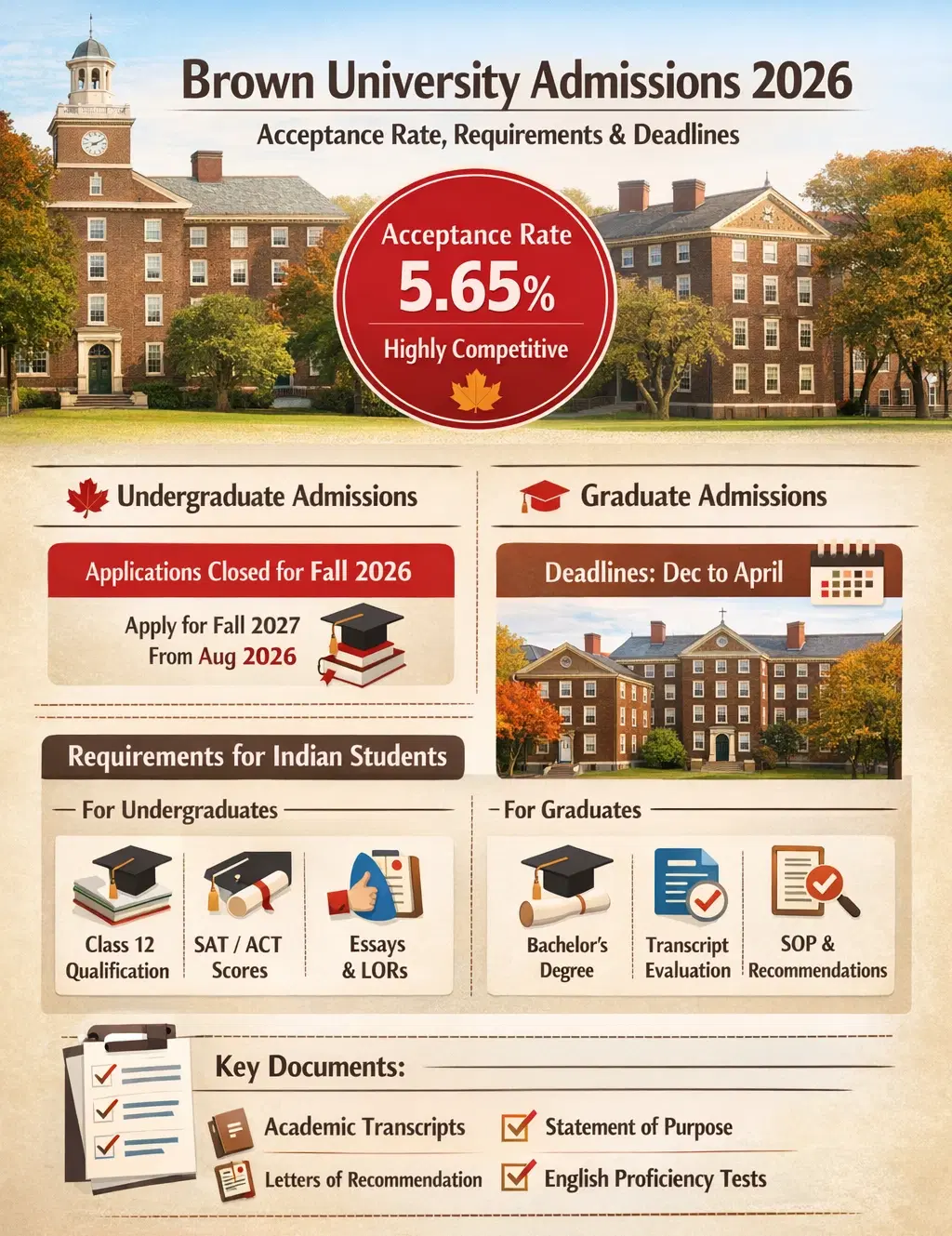
Admissions at Brown University are holistic, context-driven, and academically rigorous. Below is a structured breakdown for undergraduate, graduate, and international applicants.
Brown evaluates first-year applicants through the Common Application + Brown Supplement, emphasizing academic strength and intellectual alignment with the Open Curriculum.
GPA Expectations:
Brown does not publish a minimum GPA. However, competitive applicants typically:
For Indian applicants:
Brown evaluates transcripts in the context of school profile, grading scale, and curriculum difficulty, which are carefully considered.
SAT/ ACT Policy:
Brown has reinstated standardized testing requirements for applications from 2024-25 onwards
Mid-50% range (recent admitted class):
There is no minimum cutoff, but applicants below these ranges must demonstrate exceptional strengths elsewhere.
Letters of Recommendation:
Required:
Portfolio (If Applicable):
Required for:
The general eligibility criteria for undergraduate programs at Brown University are as follows:
Must check: Requirements to study in USA
Graduate admissions at Brown are program-specific and decentralized by department. Each department determines:
GRE/ GMAT Requirements:
Brown University GRE/ GMAT requirements vary by program:
Tabulated below are a few popular master’s programs at Brown, along with their annual tuition fees and prerequisites.
| Program | Annual Tuition Fee (USD/ INR) | Eligibility | Prerequisites | Notes for Indian Students |
|---|---|---|---|---|
| MS Computer Science | 43,908 (39.92 lakhs) | Undergraduate degree in Computer Science | - Programming- Algorithms and Data Structures - Computer Systems or Software Engineering (preferably both) - Maths & Probability - Linear Algebra |
- GRE not required, but encouraged |
| MS Data Science | 40,784 (37.08 lakhs) | Undergraduate degree in a related field | - Calculus - Linear Algebra - Calculus-based probability and statistics - Programming - Familiarity with Python/ R |
- Ability to write code is essential |
| MS Biotechnology | 37,280 (33.89 lakhs) | Undergraduate degree in a science field | None | - Biology, neuroscience, biochemistry, physics, or chemistry undergraduate degree preferred |
| MS Innovation Management and Entrepreneurship | 76,200 (69.28 lakhs) | Undergraduate degree | None | - STEM course with an entrepreneurship focus - 2 Video essays are required for admission |
| MS Physics | 81,960 (74.52 lakhs) | Strong background in Physics or closely related subjects at the undergraduate level | None | - GRE is recommended, but not required - 2 LORs are required - Apply at least 3 months before for a smooth visa process |
Note: Brown University does not set a minimum GPA requirement. However, applicants with a GPA below 3.0 (on a 4.0 scale) are encouraged to submit additional academic evidence to demonstrate readiness for their intended program.
Brown University’s executive MBA is a 15-month, hybrid Executive MBA (EMBA) offered jointly by Brown University and IE Business School. The program combines online learning with five in-person residencies in Madrid (Spain), Providence (USA), and Cape Town (South Africa), fostering global exposure and collaboration. It is highly ranked and placed 5th globally in the QS Executive MBA Rankings 2025.
Here is a step-by-step guide on how to apply to Brown University from India.
Step 1: Choose Your Program
Explore the courses offered by Brown, review academic prerequisites, and program-specific requirements before proceeding.
Step 2: Prepare Required Documents:
Start gathering:
Preparation should begin at least 3-4 months before deadlines.
Step 3: Submit Application via Common App:
Undergraduate applicants must apply through the Common Application, selecting Brown and completing:
Graduate applicants apply directly through the relevant departmental portal.
Step 4: Pay Application Fee:
Step 5: Submit Test Scores:
Scores can typically be self-reported initially, but must be verified upon enrollment.
Step 6: Track Your Applicant Portal:
After submission, Brown provides access to an applicant portal where you can:
Missing documents are a common cause of delays - monitor actively.
Step 7: Interview (If Required):
Read more: How to apply to US Universities?
Brown University has remained extremely selective over the past three admission cycles, with acceptance rates consistently below 6%. As of Fall 2025, Brown University acceptance rate is 5.65% (as per official statistics published by Brown).
| Metric | Latest Data (Most Recent Cycle) |
|---|---|
| Acceptance Rate | 5.65% |
| Average GPA | No official average published; majority in top 5–10% of class |
| SAT Range (Mid-50%) | 1480-1560 |
| ACT Range (Mid-50%) | 34-36 |
| % International Students | ~14-15% (Undergraduate) |
| Total Applicants | 42,765 |
Brown’s Early Decision (ED) data from Fall 2023 to Fall 2025 reveals a volume-driven acceptance shift rather than a policy shift in selectivity.
The Regular Decision (RD) pool mirrors the same structural pattern:
More information can be found on Brown University acceptance rate.
Brown University’s admissions statistics reinforces one clear reality: selectivity at Brown is structural, not cyclical. With an overall acceptance rate of 5.65%, stable enrollment targets, and consistently controlled class sizes, admission competitiveness is driven less by fluctuating applicant numbers and more by institutional strategy.
The recent rise in Early Decision acceptance rates (to ~17–18%) reflects declining ED volume rather than relaxed standards. Regular Decision remains intensely competitive at around 4%, underscoring that Brown’s admissions philosophy prioritizes class composition and fit over expansion. Even as applicant numbers slightly decline year-over-year, Brown continues to protect yield, academic profile, and global reputation.
Ques: What GPA do you need for Brown?
Ans: There is no official minimum GPA at Brown University. However, most admitted students are at the top of their class, typically with a 3.9+ GPA (unweighted) in a highly rigorous curriculum (IB, AP, A-Levels, CBSE ISC with strong grades).
Ques: Is Brown test-optional in 2025?
Ans: No. For the 2025 admission cycle, Brown has reinstated standardized testing requirements. Applicants are generally required to submit SAT or ACT scores, unless they qualify for a specific exemption.
Ques: What is Brown’s ED acceptance rate?
Ans: Brown’s Early Decision (ED) acceptance rate is around 17–18%, which is significantly higher than Regular Decision (around 4%). However, ED applicants are typically very strong and well-aligned with Brown.
Ques: Does Brown offer scholarships to international students?
Ans: Yes. Brown offers need-based financial aid to international students. It does not offer merit scholarships. Financial aid is based on demonstrated financial need, and admitted international students can receive substantial support.
Ques: Can I apply without the SAT?
Ans: Generally, no. Since Brown has reinstated testing requirements, most applicants must submit SAT or ACT scores. Always check the official admissions page for any updated testing policies.
Ques: How competitive is Brown for CS?
Ans: Computer Science at Brown is extremely competitive. While Brown does not admit by major for undergraduates, applicants interested in CS are evaluated in the context of a highly competitive applicant pool with strong math, coding, and research backgrounds.
Brown University in Providence, Rhode Island, United States placement details include salary insights, top recruiters, and hiring trends to help students understand career outcomes and campus opportunities.
Students usually compare highest package, average package, and recruiter profile before applying. This section gives a compact overview of career outcomes and placement visibility in Providence, Rhode Island, United States.
Represents the top salary package reported in the available placement information.
Shows the typical package range students may expect based on the available average salary data.
Placement information is currently limited.
More salary or recruiter data may be updated later for this college.
Year-wise highlights from global and country rankings available for this university.
One Prospect Street, Providence, Rhode Island 02912
+1-401-863-1000
+1-866-441-2422
Overall sentiment and category-wise rating summary
Overall score
Based on 2 ratings
Visual summary of rating distribution and categories