
Placement Metric
Highest Package
N/A
Represents the top salary package reported in the available placement information.

Explore overview, courses, fees, admissions, campus life, scholarships and student accommodation guidance in one premium Admistay guide.
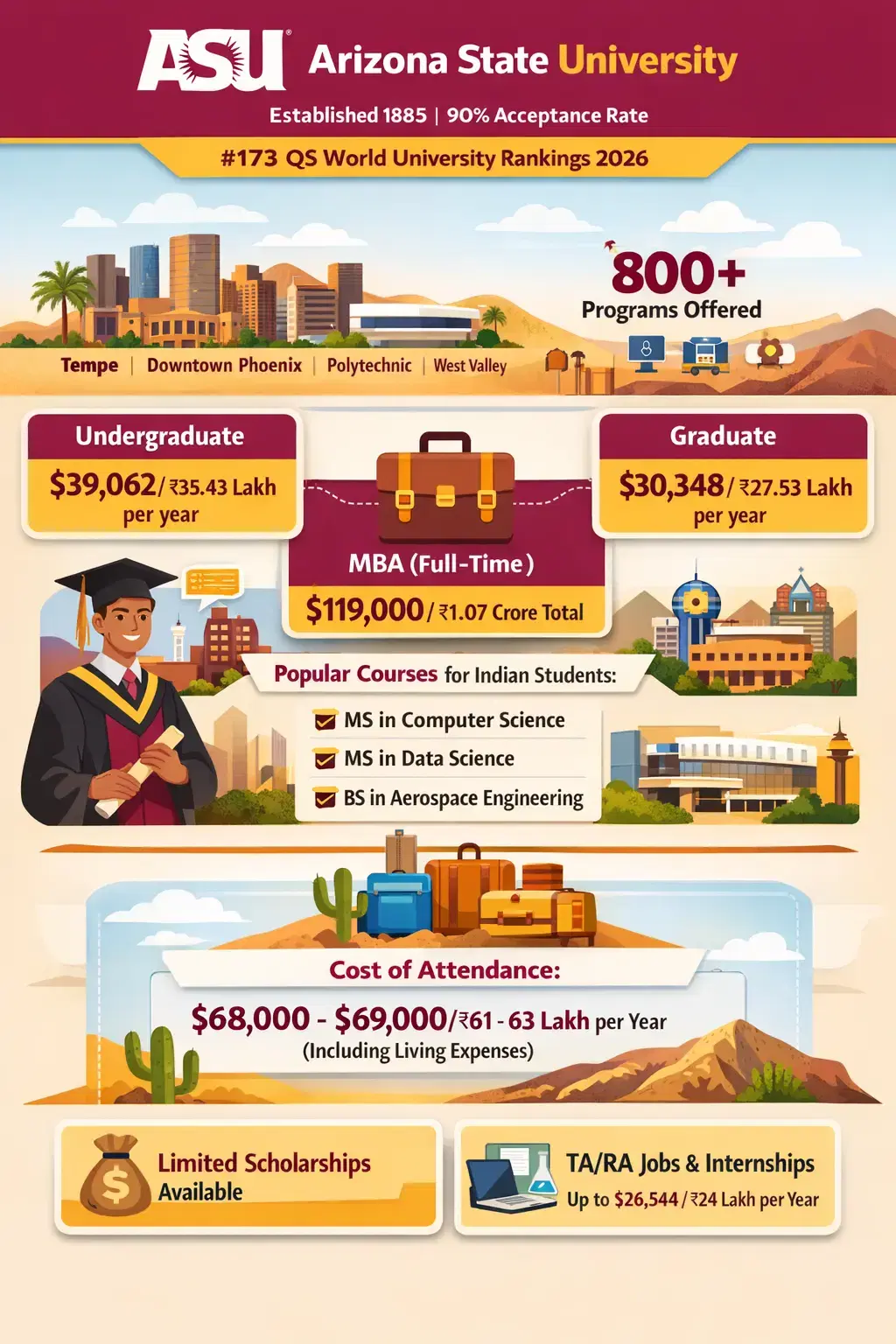
Arizona State University (ASU) is a large public research university in Phoenix, established in 1885. It has 4 campuses spread across the Phoenix metropolitan area: Tempe (main), Downtown Phoenix, Polytechnic, and West Valley. According to QS World University Rankings 2026, ASU is ranked at #173, securing a top-200 spot. It is ranked #1 in the USA for innovation for 11 consecutive years (US News & World Report, 2016-2026). With an acceptance rate of about 90% (fall 2025), the university offers Fall and Spring intakes for international admissions.
At ASU, courses such as MS Computer Science, Data Science, Robotics, and Electrical Engineering are preferred by Indian applicants. At the undergraduate level, BS in Computer Science and BS in Aerospace Engineering are among the top choices. Besides the in-person programs, ASU has a notable presence in online education.
According to the official website of the university, ASU fees for international students are as follows:
Campuses of ASU are located across the Phoenix metropolitan area, which is generally more affordable than major U.S. cities like Los Angeles or New York City. Based on ASU’s estimates, international students spend around $27,000 to $32,000 (₹24.81 to 29.40 lakhs INR) per year on living expenses. While scholarships are limited, ASU offers TA/RA assistantships up to $26,544/ year (24.02 lakhs INR). Student discussions on Reddit frequently highlight on-campus jobs and internships as the most common ways international students manage expenses.
Currency conversion used: $1= 91.89 INR as of March 11, 2026.
2.1 Arizona State University Fees
3.1 Arizona State University Acceptance Rate
7.1 Employment Rate and Average Salaries of ASU Graduates
7.2 Labor Market Insights from ASU’s Seidman Institute
| Parameter | Details |
|---|---|
| Founded | 1885 |
| Location | Phoenix Metropolitan area, Tempe, Arizona |
| University Type | Public research university |
| Acceptance Rate | ~89-90% |
| Popular Courses Among Indians | - MS Computer Science - MS Data Science - MS Robotics - MS Electrical Engineering |
| Average Annual Tuition Fees | - Undergraduate: $39,062 (35.43 lakhs INR) per year - Graduate: $30,348 (27.53 lakhs INR) per year for most programs - Full-time MBA: $119,000 (1.07 crores INR) total |
| QS Ranking 2026 | #173 |
| Graduate Employment Rate | Around 90% |
| Graduate Salary | - Business graduates: $62,000 USD (56.25 lakhs INR) - Engineering graduates: $60,000 to $70,000+ USD (54.53 to 63.51 lakhs INR) |
ASU offers more than 800 programs in a wide range of disciplines through its 19 interdisciplinary schools and colleges. A few popular programs at ASU among Indian students are tabulated below.
| Program | Annual Fees In USD | Annual Fees In INR | Admission Requirements for Indian Students |
|---|---|---|---|
| MS Computer Science | 30,348 | 27.53 Lakhs | - Bachelor's degree or equivalent with a GPA of 3.0 on a 4.0 scale (75% equivalent) - GRE not required. |
| MS Business Analytics | 67,500 | 61.21 Lakhs | - Bachelor's degree or equivalent with a GPA of 3.0 on a 4.0 scale (75% equivalent) - GMAT or GRE required |
| MS Data Science Analytics and Engineering | 30,348 | 27.53 Lakhs | - Bachelor's degree in engineering, math, or related field with a GPA of 3.0 on a 4.0 scale (75% equivalent) - GRE not required. |
| MS Robotics and Autonomous Systems - Artificial Intelligence | 30,348 | 27.53 Lakhs | Bachelor's degree in engineering or related field with a GPA of 3.0/4.0 (75% equivalent) - GRE not required |
| MS Electrical Engineering | 30,348 | 27.53 Lakhs | - Bachelor's degree in electrical engineering or related field with a GPA of 3.0/4.0 (75% equivalent) - GRE not required |
| MS Construction Management and Technology | 30,348 | 27.53 Lakhs | - Bachelor's degree in construction or related field with a GPA of 3.0/4.0 (75% equivalent) - GRE not required. |
| MS Supply Chain Management | 66,000 | 59.85 Lakhs | - Bachelor's degree with GPA 3.0/4.0 (75% equivalent) - GMAT/GRE required. |
| BS Computer Science | 39,062 | 35.43 Lakhs | - High school diploma with GPA 3.0/4.0 (61% from CBSE and 50% from CISCE) - 3 years of high school coursework (grades 9-11 if ongoing, 10-12 if completed) - ACT/SAT optional. |
| BSE Aerospace Engineering | 39,062 | 35.43 Lakhs | - High school diploma with GPA 3.0/4.0 (61% from CBSE and 50% from CISCE) - 3 years of high school coursework - Options SAT/ ACT |
Tuition at ASU varies depending on the level of study. The figures below represent approximate annual base tuition, excluding additional mandatory fees.
| Program Level | Estimated Annual Tuition (USD) | Approx. Cost (INR) |
|---|---|---|
| Undergraduate (BS) | $39,062 | ₹35.53 lakhs |
| Graduate (MS & most programs) | $30,348 | ₹27.60 lakhs |
Key Points:
Additional Mandatory Fees for International Students:
Along with tuition, students at ASU are required to pay university-wide fees that support campus services, technology infrastructure, and student activities.
| Fee Category | Undergraduate | Graduate |
|---|---|---|
| Tuition Surcharge | $350 (₹31,837) | $350 (₹31,837) |
| Advanced Technology Fee | $200 (₹18,193) | $200 (₹18,193) |
| College / Student Support Fees | $2,190 (₹1.99 lakhs) | $300 (₹27,290) |
| Student-Initiated Fees | $807 (₹73,409) | $807 (₹73,409) |
The undergraduate programs at ASU have a standard application deadline; however, graduate programs have variable application deadlines depending on the program. Based on the general historical trends of application deadlines at ASU, it is estimated that these will be the undergraduate deadlines for 2027 intakes.
| Intake | Deadline |
|---|---|
| Fall 2027 | Jan 15, 2027 (Priority) |
| Fall 2027 (Enrollment deposit) | May 1, 2027 |
| Spring 2027 | Nov 1, 2026 (Priority) |
| Spring 2027 (Enrollment deposit) | Dec 1, 2026 |
Note: These tentative deadlines will be updated once the deadlines for 2027 are officially released. For graduate deadlines, visit ASU International Admissions.
Arizona State University is generally categorized as moderately selective for admission, not highly competitive like Ivy League schools, but not open-access either. According to the Fall 2025 data, the overall acceptance rate of ASU is around ~89–90%.
It indicates that most applicants who meet the academic and documentation requirements receive offers, though meeting minimum criteria doesn’t guarantee admission for every program.
This selectivity profile means that ASU values holistic eligibility (GPA, test scores, fit with the program) and encourages early applications for preferred intakes and financial support.
For more information on statistics and trends, visit the Arizona State University acceptance rate page.
Arizona State University’s Tempe campus is the university’s largest and most active location, serving 50,000+ students. Spread across hundreds of acres in the Phoenix metro area, it combines urban energy with iconic landmarks like Palm Walk and Sun Devil Stadium.
Glimpses of the Tempe campus can be found here.
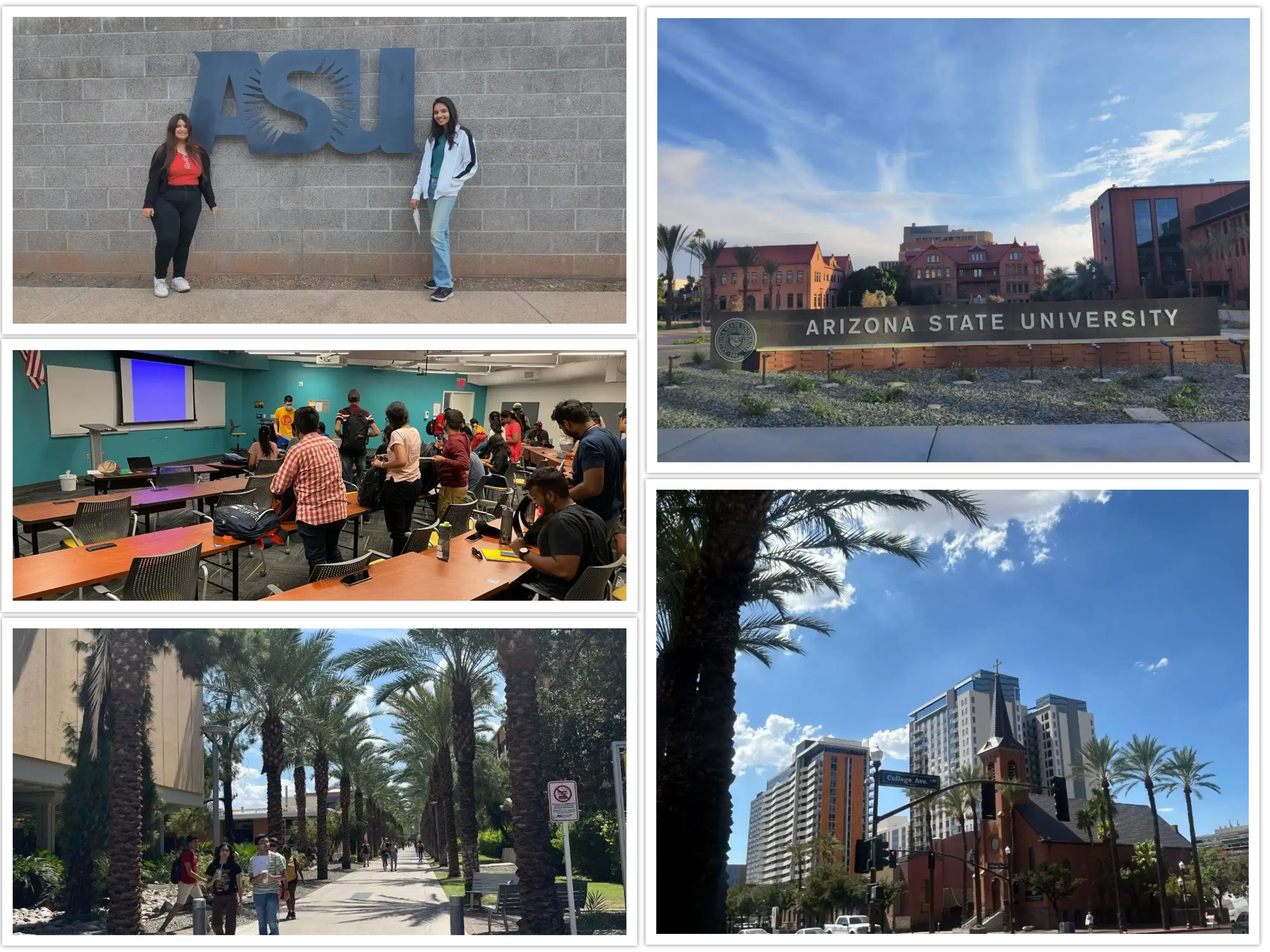
Arizona State University Tempe campus is located in Arizona, part of the Phoenix metropolitan area. It is a large student-friendly college city with warm weather, good public transport connectivity, and relatively lower living costs than cities like Los Angeles or New York. However, student reviews on Reddit state that, due to the desert climate, air-conditioning and summer electricity use can increase utility expenses in the Phoenix metropolitan area.
As per the estimates provided by ASU, the annual cost of living in ASU for international undergraduate and graduate students is as follows:
| Expense Category | Cost for Undergraduates (USD / INR) | Cost for Graduates (USD / INR) |
|---|---|---|
| Books & Supplies | $1,320 (₹1.20 lakhs) | $1,908 (₹1.73 lakhs) |
| Housing & Food | $18,819 (₹17.08 lakhs) | $21,087 (₹19.13 lakhs) |
| Transportation | $1,650 (₹1.50 lakhs) | $3,696 (₹3.35 lakhs) |
| Personal Expenses | $2,343 (₹2.13 lakhs) | $4,785 (₹4.34 lakhs) |
| Health Insurance | $2,765 (₹2.51 lakhs) | $3,189 (₹2.89 lakhs) |
| Other Fees (Intl + Loan) | $472 (₹42,800) | $1,204 (₹1.09 lakhs) |
Check out the detailed video on the ASU Tempe Campus
Arizona State University offers limited merit-based scholarships to international undergraduate students. The New American University (NAMU) scholarship is the main merit-based scholarship for incoming international undergraduate students at ASU.
For graduate students, there is no general merit-based scholarship, except departmental awards. However, ASU offers assistantships (TA/ RA) to international graduate students, with stipends of up to $26,544 (24.02 lakhs INR) per academic year. For more details on the award, visit the scholarships offered by Arizona State University.
Indian students can also explore popular external scholarships to study in USA for more options.
Note: Students must check the official ASU scholarship portal for the latest information.
Arizona State University continues to strengthen its global employer perception. According to the latest Global Employability University Ranking and Survey (GEURS):
Notably, ASU ranks ahead of globally recognized institutions such as University of California, Los Angeles, University of Michigan, Purdue University, University of Melbourne, LMU Munich, and King's College London in employer reputation metrics (Source: ASU News published on October 30, 2025).
STEM OPT Advantage at ASU:
Many ASU programs in engineering, computer science, data analytics, and supply chain qualify for the 24-month STEM OPT extension, allowing international students up to 3 years of US work authorization post-graduation. This significantly enhances ROI potential compared to non-STEM programs.
Seidman Research Institute, part of the W. P. Carey School of Business, maintains a database to track employment trends across U.S. states and metropolitan areas using data from the U.S. Bureau of Labor Statistics. Students can use the ASU Seidman Institute job growth by State database to analyze job growth by industry, state, or metro area. It is very useful for understanding labor market trends before entering the workforce and selecting a course at ASU. According to the database, the latest employment findings are:
Visit the jobs in USA for Indian students for more information.
Arizona State University continues to rank within the top 200 globally and among the top 120 universities in the U.S. across major ranking frameworks.
| Ranking Body | ASU Ranking 2026 |
|---|---|
| QS World University Rankings | #173 (Global) |
| U.S. News & World Report (National Universities) | #117 (U.S.) |
| Times Higher Education (THE) | #201-250 (Global band) |
ASU sits in the upper mid-tier of large U.S. public research universities globally. While it may not compete with Ivy League institutions on prestige metrics, it performs strongly on innovation, research output, and impact indicators. For more detailed analysis on trends and subject-specific rankings, visit ASU rankings.
How does ASU compete with similar universities?
- University of Arizona: Similar global band; marginally stronger in select research metrics.
- Texas Tech University: Generally ranked below ASU in global listings.
- University of Utah: Comparable research profile; ranking positions often overlap depending on methodology.
Indian students can consider the following pointers while considering ASU to study in USA:
Arizona State University represents a large-scale, opportunity-driven U.S. public university rather than an ultra-selective institution. The Arizona State University world ranking of #173 in QS 2026 places it within the top 200 universities globally, while the consistent #1 innovation ranking in the U.S. highlights its emphasis on research, technology integration, and industry collaboration.
The ASU campus system, including the Arizona State University Tempe campus, offers 800+ programs across 16+ colleges, alongside flexible options through online education as well. Strong employment outcomes, with ~89-90% graduates securing jobs within 90 days, further strengthen its appeal.
Ques: Is ASU good for Computer Science?
Ans: Yes. Computer Science at Arizona State University is offered through the Ira A. Fulton Schools of Engineering, one of the largest engineering schools in the U.S. The program emphasizes AI, cybersecurity, software engineering, and data science, with strong industry alignment. Proximity to Phoenix’s growing tech and semiconductor ecosystem improves internship and job prospects, especially for students targeting STEM OPT pathways.
Ques: How competitive is ASU admission for Indian students?
Ans: ASU is considered moderately selective, with an overall acceptance rate near 88-90%. For Indian students, meeting academic eligibility (roughly equivalent to a 3.0/4.0 GPA) and English proficiency standards is key. Competitive programs like Computer Science, Business Analytics, and Engineering may require stronger academic profiles. Early application improves scholarship consideration and housing access.
Ques: Does ASU require the GRE in 2026?
Ans: GRE requirements vary by program. Many graduate programs at ASU have adopted test-optional or waived GRE policies, particularly in engineering and business analytics. However, some specialized or research-intensive programs may still recommend or require GRE/GMAT scores. Applicants should always verify requirements directly on their specific department’s admissions page.
Ques: Is ASU expensive for international students?
Ans: ASU’s annual cost (tuition + living) typically ranges between $65,000–$75,000 USD. This places it in the mid-range among large U.S. public universities- generally more affordable than many private institutions and some flagship state universities. Scholarships and assistantships can significantly reduce net costs, particularly for high-performing applicants.
Ques: What GPA is required for ASU?
Ans: For undergraduate admission, ASU generally expects the equivalent of a minimum 3.0 GPA on a 4.0 scale in core academic subjects. For graduate programs, a 3.0 GPA in a relevant bachelor’s degree is commonly required, though competitive programs may prefer higher academic performance. Strong SOPs and LORs can strengthen borderline applications.
Ques: Does ASU offer good placement opportunities?
Ans: Yes. ASU ranks #2 among U.S. public universities for employable graduates in the Global Employability University Ranking. Around 90% of graduates secure employment or offers within 90 days. Major recruiters include Amazon, Intel, Microsoft, Deloitte, and Honeywell. STEM programs further benefit from extended OPT work authorization.
Explore tuition, duration, language, eligibility, and exam requirements without the clutter.
Courses
161
Fee from
₹34,51,576.32
Exams
TOEFL · IELTS
Showing 5 of 48 bachelors
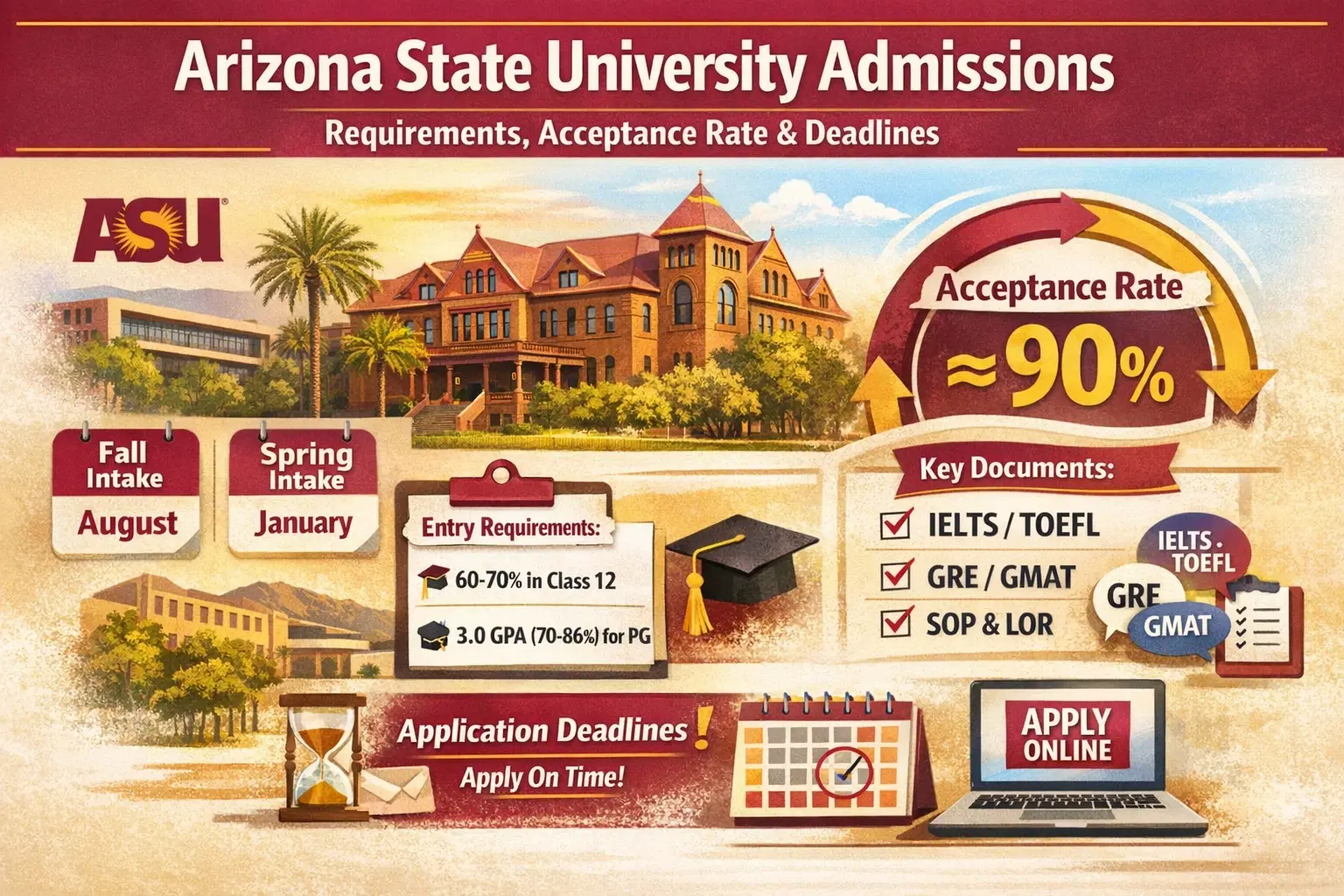
Arizona State University is one of the largest public research universities in the United States and follows a rolling admission process for most undergraduate and graduate programs. For the 2026-27 academic cycle, the university offers multiple entry terms, primarily Fall (August) and Spring (January), with Fall serving as the primary intake for the majority of programs and scholarships.
With an overall acceptance rate of approximately 89-90% (based on recent institutional data), ASU maintains a broad-access admission model at the university level. However, selectivity can increase significantly for capacity-constrained and high-demand programs such as engineering, business, and computer science.
Arizona State University follows a rolling admission process. This means applications are reviewed as they are received. There is no single hard cutoff like many private universities. However, ASU sets priority deadlines for each intake. Applying by these dates is strongly recommended, especially for:
For Fall 2026, the undergraduate priority deadline was January 15, 2026. Applications may continue to be reviewed afterward, depending on program capacity. ASU does not offer an Early Action or Early Decision round. All applications are considered under rolling review. Tentative application deadlines for 2027 are as follows:
Note: The deadlines are tentative based on the 2026 schedule published by ASU. The actual deadlines will be updated here once ASU publishes them.
Application deadlines for graduate programs at ASU vary depending on the programs. The general application timeline is as follows:
Note: Application deadlines for popular graduate programs are given in the requirements section below.
Undergraduate applicants can apply via:
Both routes lead to the same evaluation process. There is no admission advantage to choosing one over the other. An application fee of $85 (7,722 INR) is required for undergraduate applications to ASU.
Graduate applicants must apply:
An application fee of $115 (10,448 INR) must be paid by international students applying to graduate programs at ASU.
Graduate admission at ASU is department-driven. Unlike undergraduate admissions, where eligibility standards are centralized, graduate decisions are made by individual academic units. Applicants must hold:
Note: Some competitive programs, such as Business, Engineering, or Computer Science, may have higher GPA or GRE expectations.
For Indian applicants:
Admission requirements and upcoming deadlines for a few popular graduate programs of ASU are tabulated below:
| Program | Annual Fees ($/ INR) | Admission Requirements for Indian Students | Upcoming Application Deadline |
|---|---|---|---|
| MS Computer Science | 30,348 (27.53 Lakhs) | - Bachelor's degree or equivalent with a GPA of 3.25 on a 4.0 scale - GRE not required. |
- Spring 2027: August 1, 2026 |
| MS Business Analytics | 67,500 (61.21 Lakhs) | - Bachelor's degree or equivalent with a GPA of 3.0 on a 4.0 scale - GMAT or GRE required |
- Fall 2026: April 1, 2026 (final for international) |
| MS Data Science Analytics and Engineering | 30,348 (27.53 Lakhs) | - Bachelor's degree in engineering, math, or related field with a GPA of 3.0 on a 4.0 scale - GRE not required. |
- Spring 2027: July 31, 2026 |
| MS Robotics and Autonomous Systems - Artificial Intelligence | 30,348 (27.53 Lakhs) | Bachelor's degree in engineering or related field with a GPA of 3.0/4.0 - GRE not required |
Spring 2027: August 15, 2026 |
| MS Electrical Engineering | 30,348 (27.53 Lakhs) | - Bachelor's degree in electrical engineering or related field with a GPA of 3.0/4.0 - GRE not required |
Spring 2027: July 31, 2026 |
| MS Construction Management and Technology | 30,348 (27.53 Lakhs) | - Bachelor's degree in construction or related field with a GPA of 3.0/4.0 - GRE not required. |
- Fall 2026: March 1, 2026 - Spring 2027: October 1, 2026 |
| MS Supply Chain Management | 66,000 (59.85 Lakhs) | - Bachelor's degree with GPA 3.0/4.0. - GMAT/GRE required. |
- Fall 2026: July 1, 2026 - Spring 2027: December 15, 2026 |
| MS Finance | 30,348 (27.53 Lakhs) | - Bachelor's degree with GPA 3.0/4.0. - GMAT/GRE not required, but preferred |
- Fall 2026: July 1, 2026 |
Note: $1= 90.85 INR used across the article for currency conversion.
Arizona State University’s W. P. Carey School of Business delivers MBA programs in multiple formats: full-time, evening (part-time), executive, and fully online. The Full-Time, Evening, and Executive MBA programs run for 21 months, while the Online MBA takes 24 months to complete.
According to recent U.S. News & World Report rankings (latest available edition), the W.P. Carey School of Business ranks #13 among public universities for full-time MBA, while for Executive MBA, it ranks #8 among public universities in the US.
Below is a summary of tuition, entry profile, intakes, and upcoming deadlines of the MBA programs of ASU.
| Program | Total Tuition Fees | Entry Requirements | Available Intakes | Upcoming Deadlines |
|---|---|---|---|---|
| Full-Time MBA | $119,000 (₹1.07 crore) | - Bachelor’s degree - GMAT/GRE required - 5 years average work experience |
Fall | Final deadline: April 1, 2026 |
| Evening MBA | $67,000 (₹60.79 lakhs) | - Bachelor’s degree - No GMAT/GRE required - 7 years average work experience |
Fall & Spring | - Fall (Final for internationals): April 1, 2026 - Spring 2026 closed; 2027 cycle opens July 2026 |
| Executive MBA | $98,500 (₹89.37 lakhs) | - Bachelor’s degree - No GMAT/GRE required - 15 years average work experience |
Fall | Fall (Final for internationals): April 1, 2026 |
| Online MBA | $74,000 (₹67.14 lakhs) | - Bachelor’s degree - No GMAT/GRE required - 7 years average work experience |
Fall, Spring & Summer | - Fall (Final for internationals): April 1, 2026 - Summer final round: April 15, 2026 |
Note: The work experiences mentioned in the above table do not imply the minimum requirement set by ASU. However, these are the average work experiences that admitted students to those programs hold. Prospective Indian students can consider them as benchmarks.
ASU’s undergraduate admission process is academically driven but not purely numbers-based. While the university has defined minimum eligibility standards, competitive majors often require stronger academic performance. Below is a detailed breakdown based on official ASU admission policies.
For first-year undergraduate applicants, ASU requires:
*For Indian students and other international applicants, GPA is evaluated after converting national grading systems into a U.S.-equivalent scale. As per the official website of ASU, grade ‘B’ generally means:
CBSE (Central Board of Secondary Education):
CISCE (ICSE/ISC – Class X & XII):
Although the published minimum GPA is 3.0, competitive programs such as:
- Engineering
- Computer Science
- Business (W. P. Carey School)
- Health-related majors
Often admit students with significantly stronger academic records (3.3-3.8+ OR 82%+). Meeting minimum eligibility does not guarantee admission to capacity-restricted majors.
Admission requirements of a few popular undergraduate programs of ASU are tabulated below.
| Program | Annual Fees ($/ INR) | Entry Requirements for Indian Students |
|---|---|---|
| BS Computer Science | $39,062 (₹35.43 lakhs) | - High school diploma with GPA 3.0/4.0 (B average). - 3 years of high school coursework (grades 9-11 if ongoing, 10-12 if completed). - ACT/SAT optional. |
| BSE Aerospace Engineering | $39,062 (₹35.43 lakhs) | - High school diploma with GPA 3.0/4.0. 3 years of high school coursework - Optional SAT/ ACT |
| BBA | $39,062 (₹35.43 lakhs) | - High school diploma with GPA 3.0/4.0. 3 years of high school coursework - Optional SAT/ ACT |
How can Indian Students Show 3 Years of High School Study?
- If you finished Class 10 (now in Class 11):
- Submit Class 9 & 10 results + latest Class 11 marks
- If you finished Class 11:
- Submit Class 9, 10 & 11 marksheets
- If you finished Class 12:
- Submit Class 9 & 10 results + Class 11 & 12 marksheets/certificates
Arizona State University has an overall acceptance rate of approximately 89%-90% based on recent institutional enrollment data (Common Data Set). This shows that ASU is moderately selective and operates as a large public research university with an access-oriented admission model. This means:
More information can be found on Arizona State University acceptance rate.
Important note: While ASU’s overall acceptance rate is high, admission to W. P. Carey and Ira A. Fulton Schools of Engineering can be more competitive due to capacity limits.
Applying to ASU is straightforward, but accuracy and timing matter. Here is the compact step-by-step process:
Choose Your Program:
Submit Your Application:
Upload Academic Transcripts:
ASU evaluates GPA, subject rigor, grade trends, and major alignment.
Submit Test Scores (If Required):
Submit only if required or if scores strengthen your profile.
Submit English Proficiency (International Students):
Pay Application Fee:
Application review begins only after fee payment.
Track Status via MyASU:
Tip: Even though ASU follows rolling admission, applying before priority deadlines improves scholarship consideration and visa processing timelines. Visit how to apply to US universities in 2026.
Below is a checklist for undergraduate and graduate applicants applying to ASU. Requirements may vary by program, but this covers the standard documentation expected from international students.
Note: Additional materials (portfolio, GRE/GMAT scores, prerequisite coursework proof) may be required depending on the selected program.
According to the official website, ASU follows a rolling admissions process - meaning decisions are released continuously after your application is complete, not on a single fixed date.
Indian students must consider academic strength, career outcomes, and long-term value before choosing a university. ASU positions itself differently from many large public universities by emphasizing innovation, research, and industry integration.
Strong Research Reputation:
ASU is classified as an R1: Doctoral University (Very High Research Activity) in USA. It consistently ranks among the top public universities for research expenditure and interdisciplinary innovation.
Reputation for Innovation:
ASU has been repeatedly recognized in U.S. higher education rankings for innovation. Check ASU rankings
Strong Industry Partnerships:
ASU maintains partnerships with:
Arizona’s growing technology corridor (especially in semiconductor manufacturing and AI) further strengthens local hiring prospects.
Popular & High-Demand Programs:
ASU is especially known for:
Many of these programs rank competitively at the national level and attract a high volume of international students.
Scale & Opportunity:
With one of the largest student populations in the United States (across campuses and online programs), ASU offers:
Is the high acceptance hurting ASU? Read in detail.
ASU positions itself as an accessible yet structured U.S. university. It is selective enough to maintain standards, but open enough to attract large numbers of international applicants. Because decisions are released within about 2–6 weeks under rolling admissions, students who apply early gain a clear advantage in course selection, housing, and visa timelines.
Ques: What are the admission requirements for ASU (first-year/undergraduate)?
Ans: ASU has straightforward requirements: a minimum 3.00 GPA (on a 4.00 scale) in competency courses, plus completion of specific high school coursework (4 years of math, 4 years of English, 3 years of lab science, etc.). Top 25% class rank, SAT 1120+ (or ACT 22+), can also qualify you—test scores are optional/not required for most programs. International students need English proficiency (e.g., TOEFL 61, IELTS 6.0). ASU is test-optional and has a high acceptance rate (~90%).
Ques: Can I get into ASU if my GPA is below the minimum or if I get denied?
Ans: Yes, many students do. If you don't meet standard requirements, ASU offers individual review (holistic evaluation). Alternatives include the ASU Earned Admission pathway: take online courses through ASU (4–8 credits depending on age) with a 2.75+ GPA to qualify for full admission- no high school GPA barrier. Reddit users often mention this for lower GPAs or non-traditional paths (e.g., GED holders).
Ques: How long does it take to get an admission decision, and how will I be notified? Ans: Decisions are typically fast (often within a few weeks after a complete application). You'll get an email with instructions to log into My ASU portal to check status, see missing items, and view your final decision (admit/deny). Some get responses in days; others in 2–4 weeks. Once admitted, the next steps (like an I-20 for internationals) open up there.
Arizona State University in Tempe, Arizona, United States placement details include salary insights, top recruiters, and hiring trends to help students understand career outcomes and campus opportunities.
Students usually compare highest package, average package, and recruiter profile before applying. This section gives a compact overview of career outcomes and placement visibility in Tempe, Arizona, United States.
Represents the top salary package reported in the available placement information.
Shows the typical package range students may expect based on the available average salary data.
Placement information is currently limited.
More salary or recruiter data may be updated later for this college.
Year-wise highlights from global and country rankings available for this university.
Overall sentiment and category-wise rating summary
Overall score
Based on 73 ratings
Visual summary of rating distribution and categories