
Read time
18 min
Charts
4 visuals
Tables
6 data blocks
FAQs
10 answered
Executive Summary
England’s Renters’ Rights Act has changed how students should think about private rentals, HMOs and PBSA. This guide explains what international students need to check before booking UK accommodation in 2026, including upfront rent, guarantors, deposits, fixed terms, rolling tenancies, eviction rules and student house shares.
Renters’ Rights Act Implementation Timeline
Key implementation milestones relevant to student renters.
Insight: Highest signal is Ombudsman at 4.
Student Accommodation Type Impact
Admistay impact score by accommodation route after Renters’ Rights Act reforms.
Insight: Highest signal is Private Rental at 90.
International Student Booking Risk by Issue
Risk score for international students booking accommodation after the 2026 reforms.
Insight: Highest signal is Upfront Rent at 92.
PBSA vs Private Rental Decision Matrix
Decision support score comparing PBSA and private rental for international students.
Insight: Highest signal is PBSA Certainty at 90.
Research Tables
Data Tables & Decision Frameworks
Structured evidence tables, source notes and Admistay decision frameworks used throughout this report.
PBSA vs HMO vs Private Rental After the Renters’ Rights Act
Legal rows are based on GOV.UK tenancy, HMO and implementation guidance. Booking window and practical risk rows are Admistay editorial analysis.
| Factor | Pbsa | Hmo Student House | Private Rental |
|---|---|---|---|
| Typical structure | Provider-specific contract, common law tenancy or licence depending on setup | Often private rented sector tenancy | Often private rented sector tenancy |
| Fixed term vs rolling | May still use academic-style fixed booking terms | More likely affected by rolling tenancy rules | More likely affected by rolling tenancy rules |
| Deposit | Provider policy must be checked | Deposit protection rules matter | Deposit protection rules matter |
| HMO licence | Usually not relevant unless structured as shared housing | Important where licensing criteria apply | Relevant only if HMO criteria are met |
Student Booking Implications of the Renters’ Rights Act
Compiled from official guidance and Admistay student booking interpretation.
| Change | What It Means | Student Action |
|---|---|---|
| Section 21 abolished | Landlords need valid grounds to end qualifying tenancies | Do not accept vague eviction wording in contract explanations |
| Rolling tenancies | Many private tenancies no longer work like old fixed-term contracts | Ask how notice and summer exit work |
| Upfront rent restricted | Large rent demands before contract clarity are higher risk | Ask exactly when rent becomes payable |
| Rental bidding banned | Advertised rent should not become a bidding competition | Save advert screenshots and avoid bidding pressure |
| Rent increases controlled | Rent increases have stricter process and timing | Ask how rent review works if staying longer |
Questions International Students Should Ask Before Paying
Admistay editorial checklist based on official policy implications.
| Question | Why It Matters |
|---|---|
| Is this PBSA, halls, HMO or private rental? | The legal structure changes your contract and notice position. |
| When exactly does rent become payable? | Large advance rent demands can be a compliance and scam risk. |
| Do you require a UK guarantor? | International students need alternatives before they commit. |
| Which deposit protection scheme will be used? | Deposit protection is a major safety signal. |
| Does the property need an HMO licence? | Shared student houses may need council licensing. |
Admistay Renters’ Rights Student Booking Risk Index
Derived decision model; not official legal ranking.
| Risk Factor | Weight | Low Risk Signal | High Risk Signal |
|---|---|---|---|
| Accommodation classification | 20% | Provider clearly explains PBSA, HMO, halls or private rental status | Advert only says student room with no legal clarity |
| Payment timing | 20% | Payment schedule is written and clear | Large upfront rent requested before contract clarity |
| Deposit protection | 15% | Deposit type and protection process are explained | Deposit requested to a personal account with no protection details |
| Guarantor pathway | 15% | International student alternatives are listed | Landlord demands guarantor or cash without explanation |
| HMO compliance | 10% | HMO licence status is clear where relevant | Large shared house but no licence information |
| Notice and exit terms | 10% | Notice process is clear | Student does not know how they can leave |
| Provider behaviour | 10% | Calm and professional communication | Pressure, urgency and vague payment requests |
Executive Summary
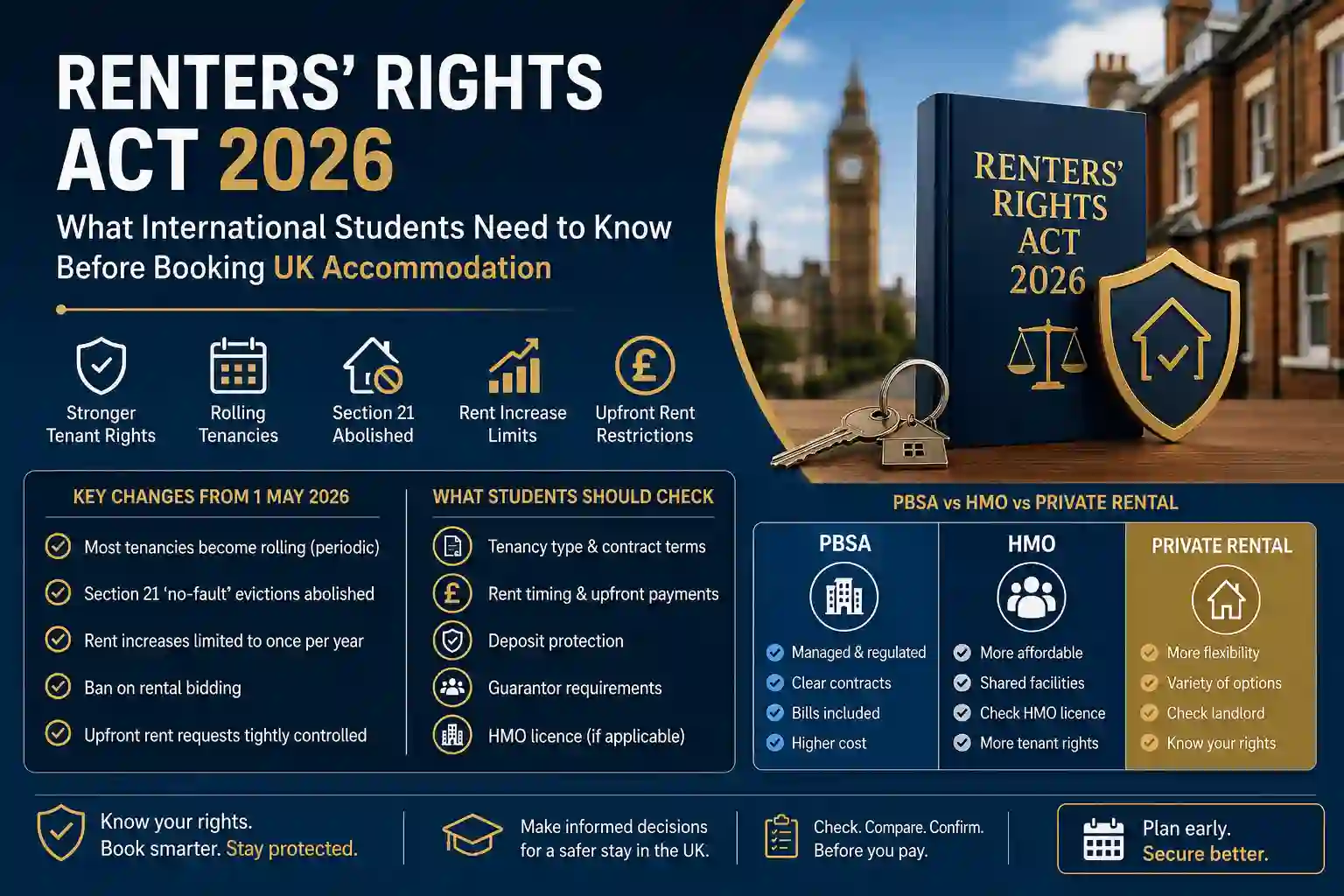
England’s Renters’ Rights Act is now a major student accommodation issue, not only a landlord issue. The first major phase took effect on 1 May 2026. It changed the way most private rented sector tenancies work, including rolling tenancies, Section 21 eviction rules, rent increases, rental bidding and rent-in-advance practices.
For students, the main point is simple: the legal structure of the room matters before the rent price. A private student house share, a standard private rental, university halls and PBSA do not all sit in the same bucket. Before paying a deposit, students should know whether they are booking PBSA, an HMO, university-managed halls or a private landlord property.
For international students, the most important issue is upfront rent and guarantor friction. Many overseas students previously used multiple months of upfront rent to compensate for not having a UK guarantor. Under the new rules, landlords and agents face tighter restrictions around rent before move-in. That may protect students from abusive payment demands, but it can also make guarantor alternatives more important.
What Changed on 1 May 2026?
The 1 May 2026 phase of the Renters’ Rights reforms changed the private rental market in England. Most private tenancies moved to assured periodic tenancy structures, meaning they run on a rolling basis rather than having a fixed end date in the traditional way.
Section 21 no-fault eviction notices were abolished for new use under the new framework. This means private landlords generally need a valid legal ground to end a qualifying tenancy. For students in normal private rentals, this gives stronger protection once they are living in the property.
Rent increases also became more controlled. In general, landlords can increase rent only once a year through the correct process and must give proper notice. Rental bidding is also banned, meaning landlords and agents should not encourage students to offer above the advertised rent.
The most important booking issue is rent in advance. Students should be careful if a landlord asks for a large upfront payment before signing the agreement. Under the new framework, rent timing and pre-tenancy payment demands are much more sensitive.
Does the Act Apply to PBSA, HMOs and Private Rentals in the Same Way?
No. This is the biggest student misunderstanding. Student accommodation is not one single legal category.
A student renting from a private landlord is likely to be under the private rented sector framework. That includes many shared student houses, private flats and local landlord rentals. A student living in university halls or private halls may have a different legal structure, often a licence or common law tenancy.
PBSA can also sit differently from a normal private house share. Many PBSA contracts may still be structured around academic-year-style booking models. That means students must ask the provider directly: what is the legal structure of this agreement?
HMOs are another important area. A student house with multiple unrelated tenants sharing facilities may be an HMO. Larger HMOs usually need local council licensing. Students should check HMO status before paying because licensing affects safety, compliance and landlord accountability.
PBSA vs HMO vs Private Rental After the Renters’ Rights Act
| Factor | PBSA | HMO Student House | Private Rental Flat or House |
|---|---|---|---|
| Typical legal structure | Often provider-specific contract, common law tenancy or licence depending on setup | Often private rented sector tenancy if rented from a private landlord | Often private rented sector tenancy |
| Fixed term vs rolling | May still use academic-year-style fixed booking terms in many cases | More likely to be affected by rolling tenancy rules | More likely to be affected by rolling tenancy rules |
| Deposit risk | Provider policy must be checked | Deposit protection and holding deposit rules matter | Deposit protection and holding deposit rules matter |
| Upfront rent issue | Depends on provider policy and contract structure | Large advance rent requests require careful checking | Large advance rent requests require careful checking |
| Guarantor issue | Often still requested, but alternatives may exist | Commonly requested by landlords | Commonly requested by landlords |
| HMO licence | Usually not relevant unless structured as shared housing | Very important for larger shared houses | Only relevant if HMO criteria are met |
| Best for | First-year international students wanting managed support | Returning students and groups who know the city | Postgraduates, couples or independent renters |
What International Students Should Check Before Booking
First, classify the property. Ask whether the accommodation is PBSA, university halls, an HMO house share or a standard private rental. This one answer changes the rest of the booking checks.
Second, ask about rent timing. Do not send large upfront rent before understanding whether the request is allowed, when the agreement is signed and what exactly the payment covers.
Third, ask about guarantor alternatives. The reforms do not remove guarantor checks in general. International students without a UK guarantor should ask early whether the provider accepts international guarantors, guarantor services, staged payments or other alternatives.
Fourth, check the deposit. Ask whether the payment is a holding deposit, tenancy deposit, booking fee or rent in advance. These are not the same thing.
Fifth, confirm the notice period. Rolling tenancies can be good for flexibility, but students still need to understand how and when they can leave.
Sixth, check HMO licensing. If you are booking a shared house with several other students, ask whether the property requires an HMO licence and request the licence number if applicable.
Student Booking Checklist Before Paying
- Ask whether the property is PBSA, university halls, an HMO or a standard private rental.
- Request the tenancy type in writing.
- Ask whether the contract is fixed term, rolling, licence-based or provider-specific.
- Confirm whether a holding deposit is required and whether it is refundable.
- Confirm the tenancy deposit amount and protection route.
- Ask when rent becomes payable and whether any upfront rent request follows current rules.
- Ask whether a guarantor is required and what alternatives exist for international students.
- If it is a shared house, ask whether it needs an HMO licence.
- Confirm bills, fair-usage caps, laundry, internet and maintenance process.
- Save the advert, payment request, contract, email thread and screenshots before transferring money.
Admistay Renters’ Rights Student Booking Risk Index™
The Admistay Renters’ Rights Student Booking Risk Index™ is a decision framework for students comparing PBSA, HMOs and private rentals after the 2026 reforms. It is not an official legal ranking. It is designed to help students spot contract and payment risk before booking.
| Risk Factor | Weight | Low Risk Signal | High Risk Signal |
|---|---|---|---|
| Accommodation classification | 20% | Provider clearly explains PBSA, HMO, halls or private rental status | Advert only says student room with no legal clarity |
| Payment timing | 20% | Payment schedule is written and follows current guidance | Large upfront rent requested before contract clarity |
| Deposit protection | 15% | Deposit type and protection scheme are explained | Deposit requested to a personal account with no scheme information |
| Guarantor pathway | 15% | International student alternatives are clearly listed | Landlord demands guarantor or large cash payment without explanation |
| HMO compliance | 10% | HMO licence position is clear where relevant | Large shared house but no licence information |
| Notice and exit terms | 10% | Notice process is clear in writing | Student does not know how they can leave |
| Provider behaviour | 10% | Calm, documented and professional communication | Pressure, urgency, vague contract and payment push |
Sample Email Templates Students Can Use
Template 1: Asking About Tenancy Type
Hello, I am an international student interested in this accommodation. Before I proceed, please confirm whether this is PBSA, university halls, an HMO student house or a standard private rental. Please also confirm the tenancy type, contract length, notice period, deposit amount, rent payment timing and whether a guarantor is required.
Template 2: Asking About Upfront Rent
Hello, before I make any payment, please confirm when the tenancy agreement will be signed and when rent becomes payable. Please also confirm whether any rent is required before signing and what each payment represents.
Template 3: Asking About HMO Licence
Hello, please confirm how many tenants will live in this property, whether the property requires an HMO licence, and if yes, please share the licence number or local council registration details.
Example Scenarios
Scenario 1: Priya, an international postgraduate from India. Priya is offered a room in a private student house in Manchester. The landlord asks for six months of rent before sending the contract because Priya does not have a UK guarantor. Priya should not rush the payment. She should ask for the tenancy type, payment schedule, deposit protection, HMO status and guarantor alternatives in writing. If the landlord refuses, she should compare verified PBSA or a provider with a published international student payment route.
Scenario 2: Tom, a UK second-year student. Tom and four friends are booking a shared house. Because five unrelated students will live together and share facilities, the property may be a large HMO. Tom should check the licence before paying and confirm the notice structure under the new tenancy rules.
Scenario 3: A parent paying from overseas. A parent is asked to transfer a large deposit and rent payment to a personal bank account. Before paying, the parent should ask for the full contract, official payment details, provider identity, deposit protection process and written explanation of all fees.
Admistay Editorial Observations
- The Act makes many private rentals safer for students after move-in, but it does not remove the need to verify contracts before payment.
- International students may face more negotiation around guarantors because large upfront rent structures are more restricted.
- PBSA may become more attractive for first-year international students because providers usually have clearer processes, managed buildings and published payment structures.
- The biggest risk is not only rent price. It is booking the wrong legal structure without understanding payment, notice, guarantor and deposit consequences.
Final Verdict
The Renters’ Rights Act 2026 is important for students, but it does not affect every accommodation type in the same way. Private rentals and student HMOs need deeper checks around rolling tenancies, rent timing, deposits, notice and licensing. PBSA and halls need separate contract review because they may not follow the same structure as ordinary private rentals.
For international students, the safest booking decision is not simply the cheapest room. It is the room where the contract type, rent timing, deposit protection, guarantor pathway, move-in date and provider identity are all clear before payment.
Frequently Asked Questions
Student Accommodation FAQs
Practical answers for students, parents, universities and providers.
1Does the Renters’ Rights Act apply to student halls and PBSA?
Does the Renters’ Rights Act apply to student halls and PBSA?
Not in the same way as standard private rentals. Students renting from private landlords are more likely to be affected by assured periodic tenancy rules. Students in university halls or many private halls may have a different structure, such as a licence or common law tenancy.
2Can a landlord still ask an international student for six months’ rent upfront?
Can a landlord still ask an international student for six months’ rent upfront?
Students should treat large upfront rent demands very carefully. Under the new rules, rent before signing and large pre-tenancy payment requests are much more restricted. International students should ask for the payment schedule and tenancy agreement before sending money.
3Are guarantors banned under the new rules?
Are guarantors banned under the new rules?
No general guarantor ban was identified in the official guidance reviewed for this article. Students should still expect some landlords and providers to ask for a guarantor or an approved alternative.
4What happened to fixed-term student tenancies in normal private rentals?
What happened to fixed-term student tenancies in normal private rentals?
Many private rented sector tenancies moved to rolling assured periodic tenancies from 1 May 2026. Students should ask whether their contract is affected or whether it sits under a different structure such as PBSA or halls.
5How much notice does a student need to give to leave?
How much notice does a student need to give to leave?
Students in qualifying rolling tenancies should check the written notice rules carefully. The safest approach is to ask the landlord or provider to confirm the exact notice period before booking.
6Does the Renters’ Rights Act make PBSA safer than private rentals?
Does the Renters’ Rights Act make PBSA safer than private rentals?
PBSA can be safer for some international students because it usually has clearer provider identity, managed buildings and published booking processes. However, PBSA contracts still need to be reviewed carefully.
7What is the biggest risk for international students after the Renters’ Rights Act?
What is the biggest risk for international students after the Renters’ Rights Act?
The biggest risk is misunderstanding the contract type and payment structure. Students should not assume that PBSA, HMOs and private rentals follow identical rules.
8Should students still check HMO licences?
Should students still check HMO licences?
Yes. If a shared student house meets HMO criteria, licensing may be required. Students should ask for the licence number or local council confirmation where relevant.
9Can landlords still increase student rent?
Can landlords still increase student rent?
Rent increases are more controlled under the new framework for qualifying tenancies. Students should ask how rent review works, especially if they may stay beyond one academic year.
10What should parents check before paying for UK student accommodation?
What should parents check before paying for UK student accommodation?
Parents should check provider identity, contract type, deposit protection, rent timing, guarantor liability, HMO licence status, bills and move-in details before funding any payment.
Continue Research
Related student intelligence
Internal Links
Continue with the most relevant Admistay pages from this article.
Accommodation
Compare verified student rooms connected to this topic.
Admissions
Explore admissions guidance connected to this article.
Related Articles
Read the next Intelligence Hub guides on this theme.
Why trust this guide
Mayank
Student Accommodation Research Writer
Mayank writes student-first accommodation guides for Admistay Intelligence Hub, focusing on UK student housing, booking strategy, international student decision-making, PBSA, HMOs, deposits and tenancy risk.
Reviewed by
Admistay Editorial Review Desk
Student Housing & Admissions Research Review